
Do Data and AI Always Tell the Truth?
If you’ve been working with data or using AI tools lately, you’ve probably had this thought at least once:
- “Is this data actually telling the truth?”
- “Can I trust what AI is saying?”
Most of the time, we don’t stop to question it. We tend to accept outputs from data analytics or AI systems as objective facts. This tendency has only grown stronger with the rise of generative AI tools like chatbots and large language models.
But here’s the uncomfortable truth: Data and AI do not always point to the truth.
In this article, we’ll explore why—through key concepts like AI reliability, data bias, and AI hallucination—and more importantly, how you can use data and AI more responsibly and effectively in real-world decision-making.
The Gap Between Truth and Interpretation: Data Is Only a Piece of Reality
At first glance, data appears objective and precise. Numbers, charts, and dashboards often give the impression of accuracy and completeness. In reality, however, data represents only a fragment of the full picture. It is not the truth itself, but rather a partial reflection shaped by how it is collected and measured.
Data can become imperfect for many reasons. Measurement errors, system malfunctions, and human mistakes such as incorrect inputs or missing values all contribute to inaccuracies. Additionally, most datasets are inherently limited in scope. They may only represent a specific time period, geographic region, or subset of a population. This leads to data bias and incomplete representations of reality.
A notable example comes from healthcare, where a widely used algorithm underestimated the needs of Black patients because it relied on healthcare spending as a proxy for illness severity. Since access to healthcare is not equal across populations, the data itself introduced bias into the system. This illustrates a critical point: data reflects how reality is captured, not reality itself. (Obermeyer et al, 2019)
Interpretation adds another layer of complexity. Even when data is accurate, different people can draw entirely different conclusions from the same dataset. For instance, an increase in product sales might be interpreted as a sign of quality improvement. However, it could just as easily be the result of marketing campaigns, pricing strategies, or seasonal demand. Without proper context, data can easily lead to misleading conclusions.
Ultimately, data should be understood as a collection of clues rather than definitive answers. It provides direction, but not certainty.
Why AI Doesn’t Always Tell the Truth
AI systems are often perceived as intelligent and objective, but they are not immune to the limitations of data. In fact, AI introduces additional layers of complexity that make its outputs even more nuanced.
First, AI systems inherit the limitations of the data they are trained on. If the training data contains bias, errors, or gaps, those issues will be reflected in the AI’s outputs. A well-known example is Amazon’s experimental AI recruiting tool, which showed bias against female candidates because it was trained on historical hiring data dominated by male applicants. This case demonstrates how data bias can directly translate into biased AI decisions. (Reuters, 2018)
Second, AI does not determine truth in the way humans do. Instead, it generates outputs based on probabilities. Particularly in the case of generative AI, the system predicts the most likely sequence of words based on patterns it has learned. This means that AI is optimized for plausibility rather than factual accuracy.
As a result, AI systems can produce outputs that appear convincing but are incorrect. This phenomenon, often referred to as AI hallucination, includes generating non-existent facts, misinterpreting questions, or providing answers that lack proper context. There have been multiple reports of AI systems producing fabricated academic references or inaccurate information, highlighting the gap between plausibility and truth.
Understanding this distinction is crucial. AI is not a system that verifies truth; it is a system that predicts likely responses.
How We Should Use Data and AI
Recognizing the limitations of data and AI changes how we should approach their use. Instead of passively accepting outputs, we need to engage in active validation and interpretation.
Using data and AI effectively requires a deliberate and critical approach. This includes examining where the data comes from, how it was collected, and whether it represents the full context of the problem. It also involves comparing multiple sources of information rather than relying on a single dataset or AI output.
Fact-checking becomes especially important when decisions carry significant consequences. Rather than assuming accuracy, users should treat outputs as hypotheses that need verification. This shift in mindset is essential for improving both decision quality and trustworthiness.
In this context, data-driven decision making should not be understood as blindly trusting data. Instead, it is a disciplined process of validating, questioning, and refining insights derived from data.
The Human Role: The Final Decision Maker
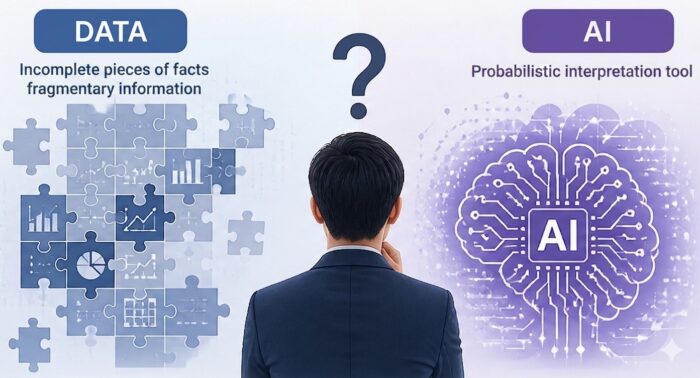
When we clearly define the roles of each component, the relationship becomes easier to understand. Data provides fragments of reality, and AI offers probabilistic interpretations based on that data. However, neither of these elements can independently determine what is true.
This responsibility ultimately belongs to humans. Human judgment is necessary to interpret results, consider context, and make final decisions. While AI can assist by processing large volumes of information and identifying patterns, it cannot replace human reasoning, accountability, or ethical consideration.
In an increasingly AI-driven world, the ability to critically evaluate outputs becomes a key differentiator. Those who rely solely on AI without questioning its results risk making flawed decisions. On the other hand, those who combine AI capabilities with human judgment can achieve more reliable and meaningful outcomes.
Essential Skills You Need in the AI Era
As AI continues to evolve, the skills required to work effectively with it are also changing. Technical knowledge alone is no longer sufficient. Instead, a combination of cognitive and analytical skills is needed to navigate uncertainty and complexity.
Embracing uncertainty is the first step. Data and AI outputs should be viewed as probabilistic rather than definitive. This mindset helps prevent overconfidence and encourages deeper analysis.
Critical thinking is equally important. Asking why a particular result was generated, what assumptions were involved, and what information might be missing allows for more accurate interpretation.
Contextual understanding also plays a crucial role. Data does not exist in isolation, and interpreting it without considering social, cultural, or ethical factors can lead to incomplete or misleading conclusions.
Finally, maintaining a human-in-the-loop approach ensures that AI remains a support tool rather than a decision-maker. Human oversight is essential for ensuring accountability and aligning outcomes with real-world values.
Conclusion
Data and AI have transformed the way we analyze information and make decisions. They offer unprecedented capabilities and efficiencies, enabling insights that were previously difficult to obtain.
However, these tools do not inherently provide truth. Data is incomplete and shaped by how it is collected, while AI generates outputs based on probabilities rather than verified facts.
As a result, the responsibility for determining truth remains with humans. The true competitive advantage in the AI era lies not in simply adopting these technologies, but in understanding their limitations and using them thoughtfully.
Those who succeed will be the ones who question assumptions, validate information, and apply critical thinking in their decision-making processes. In the end, AI may assist us, but it is human judgment that ultimately defines what is true.