
Introduction
Artificial Intelligence has captured the world’s imagination — and for good reason. Large Language Models (LLMs) like GPT-4 or open-source variants such as LLaMA and Gemini are already revolutionizing how people write emails, summarize documents, and answer everyday questions. These models are trained on vast amounts of publicly available text, enabling them to perform a broad set of tasks with impressive fluency.
However, when businesses try to apply generic LLMs directly to real enterprise workflows, the limitations quickly become clear. Corporate operations are highly specific: industries vary dramatically in their vocabulary, regulatory needs, workflows, and decision-making priorities. A one-size-fits-all AI model simply cannot understand these nuances — unless it is connected to the right enterprise data and engineered for business context.
Below, we’ll explore why enterprise-specific data is the real foundation of effective AI systems, how companies can deploy AI agents with that data, what architectural choices matter, and how to manage an ecosystem of AI agents across functions like sales, marketing, finance, and HR.
Why “AI Model Choice” Comes Second to “What the AI Understands”
Many organizations start by asking, “Which AI model should we use?” — but that’s the wrong first question.
What matters far more is: “What data does the AI have access to and how well does it understand our business?”
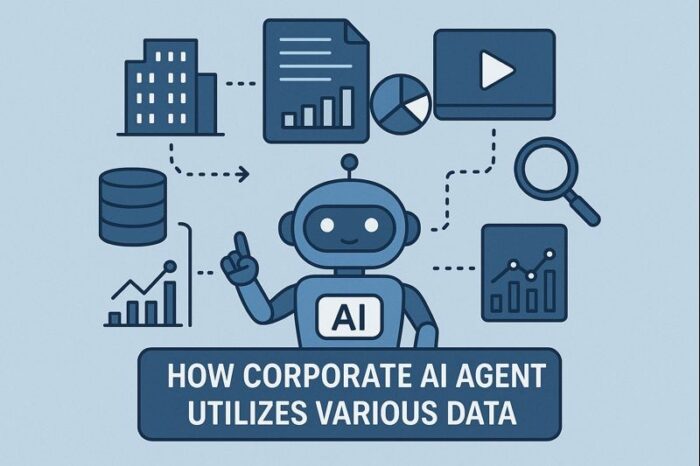
Publicly trained AI models are designed to provide broad, general knowledge, which makes them useful for a wide range of common tasks. However, real business operations are fundamentally built on proprietary data that exists only within an organization. This includes internal reports and operational manuals that define how work is actually performed, design documents that capture technical decisions and product logic, and detailed customer service histories that reflect how the company interacts with its customers over time. It also encompasses sales playbooks that guide revenue-generating activities, as well as compliance and regulatory records that shape how the business manages risk and adheres to industry requirements. Together, this proprietary data forms the foundation of how a company operates and competes—context that publicly trained AI models simply cannot infer on their own.
This internal data is essential intellectual property — knowing how your company operates is far more valuable than merely knowing facts about the world. Without integrating proprietary data, AI remains a generic tool — useful for basic tasks but fundamentally disconnected from your business reality.
The Unique Value of Enterprise Data
Enterprise data delivers advantages that public training data simply cannot:
1. Built-In Business Expertise
Internal documents encode domain-specific knowledge that no external source can replicate. For example, a semiconductor manufacturer’s process control logs or a law firm’s case notes may use terminology impossible for general models to interpret correctly without context. This internal expertise — often developed over decades — is the secret sauce that makes AI valuable in real business applications.
2. High Trust & Accuracy
Corporate data originates from real work outcomes and internal validation procedures. Errors in customer service scripts, financial forecasts, or engineering specs directly impact business performance if they go unchecked. This makes enterprise data reliably accurate and repeatable — a key ingredient for trustworthy AI decisions.
3. Contextual Decision-Making
Unlike generic data that answers “what,” company data can help AI explain “why” decisions were made — because it embeds the history of how decisions played out. This enables AI agents to support reasoning, not just reporting.
Why Enterprise Data Is Hard for AI to Use
Despite its undeniable value, enterprise data is often difficult for AI systems to use because it tends to be messy, inconsistent, and poorly structured. In many organizations, data formats are not standardized across departments, which makes it challenging for AI to interpret information consistently. A significant portion of enterprise knowledge also exists as unstructured text—such as emails, Word documents, and PDF files—written in varied styles and levels of detail. On top of this, responsibility and ownership of data are frequently unclear, making it difficult to determine which sources are authoritative or up to date. These issues are further compounded by data silos, where information is isolated within individual teams and inaccessible to others.
Artificial intelligence performs best when it operates on well-organized, semantically rich data. If enterprise data is not prepared in a way that AI can reliably interpret, or if access and security policies are fragmented, even the most powerful AI model will struggle to deliver meaningful results. In such cases, limitations in data quality and governance—not model capability—become the primary barrier to effective AI performance.
Two Paths to Enterprise AI
When organizations seek to integrate enterprise knowledge into AI systems, two main strategies typically emerge.
1. Fine-Tuning the Model
Fine-tuning involves retraining a base AI model using internal enterprise data so that it learns the organization’s specific language, priorities, and workflows. This approach enables the AI to develop a deeper and more nuanced understanding of the domain, often improving performance on highly specialized tasks. It can also help align the AI’s tone, style, and behavior with established communication norms and operational practices.
However, fine-tuning requires substantial computational resources, often in the form of dedicated GPU infrastructure, as well as experienced AI engineers to manage training and deployment. The process is time-consuming and must be repeated when significant updates are needed, which increases long-term costs. As a result, market research indicates that only around 20 percent of enterprises rely primarily on fine-tuning today. Despite its expense, fine-tuning can be highly valuable in industries where domain accuracy is mission-critical, such as healthcare and finance. (Source: The Wall Street Journal)
2. RAG (Retrieval-Augmented Generation)
RAG takes a different approach by leaving the model’s internal weights unchanged and instead augmenting its responses with real-time retrieval of relevant enterprise data. Whether the data is structured or unstructured, RAG allows the AI to search internal knowledge sources and incorporate those findings into its generated responses.
This method provides immediate access to up-to-date internal knowledge without requiring retraining. It is generally more scalable and cost-effective than fine-tuning and works particularly well in environments where data changes frequently. For these reasons, RAG has become the default strategy for many enterprises, with approximately 80 percent of organizations implementing enterprise AI adopting RAG-based systems. (Source: The Wall Street Journal)
IBM and other industry experts also emphasize that RAG improves verifiability, as AI responses can be traced back to specific internal documents. This capability is especially critical in regulated industries such as finance and healthcare. (Source: IBM TechXchange Community)
Generating Enterprise-Specific AI Agents
Using internal data effectively isn’t just about one AI — it means building multiple AI agents across the business value chain.
Instead of a generic “AI assistant,” companies can generate:
- Sales AI Agents that understand deal pipelines, pricing playbooks, and CRM workflows
- Marketing AI Agents that access campaign performance data and customer insights
- Finance AI Agents tailored to budget reports, forecasts, and audit logs
- HR AI Agents that respect policies and performance metrics
- R&D AI Agents integrated with design records and test results
These agents act like business specialists — not generic assistants — by understanding internal lexicons, criteria, and success metrics.
When these agents collaborate, the result is a network of AI capabilities — a structured system capable of supporting cross-department workflows.
Architectures for AI Agent Systems
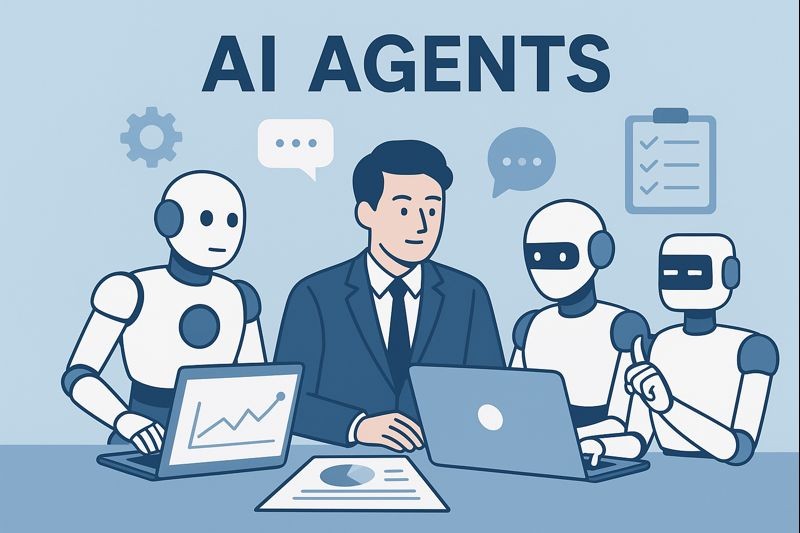
Different architectural patterns can be used for organizing AI agents:
- Single Unified AI Agent
- A single system handling all tasks across departments
- Simplifies interaction but can struggle to scale with complexity
- Super Agent + Sub-Agents
- One Super AI Agent orchestrates specialized Sub AI Agents
- Each Sub-Agent is expert in its domain (e.g., Sales, HR, Finance)
- The super agent manages context, routing, and workflow hand-offs
- Autonomous Collaboration
- Sub-Agents communicate and coordinate without a central controller
- This is more advanced and requires agents to understand each other’s states and goals
In practice, the Super-Agent architecture is often most practical: it balances governance, modularity, and integration while allowing individual agents to scale on their own.
Managing AI Agents at Scale
As organizations deploy more AI agents, governance becomes increasingly important. Managing AI agents is no longer a technical afterthought but a core part of AI strategy. This includes defining clear lifecycle processes for registering, approving, updating, and retiring AI agents, as well as mapping agents by domain and function so stakeholders can understand available capabilities.
AI catalogs and knowledge maps play a crucial role by documenting each agent’s purpose, data access, and performance metrics. Continuous monitoring of usage, output quality, and business impact ensures that AI agents continue to deliver value rather than becoming hidden operational risks. Over time, the AI catalog evolves into a knowledge graph that represents the organization’s AI ecosystem.
Conclusion
Ultimately, adopting a powerful AI model is not a strategy in itself. True success comes from building a structured, data-centric AI ecosystem grounded in proprietary enterprise data. Organizations that treat AI as a simple add-on will see limited results, while those that design intelligent, well-governed AI agent systems will fundamentally change how they work and how quickly they grow.
AI is not just a technology challenge. It is an organizational design challenge—and the companies that recognize this distinction will lead the next phase of enterprise AI adoption.