
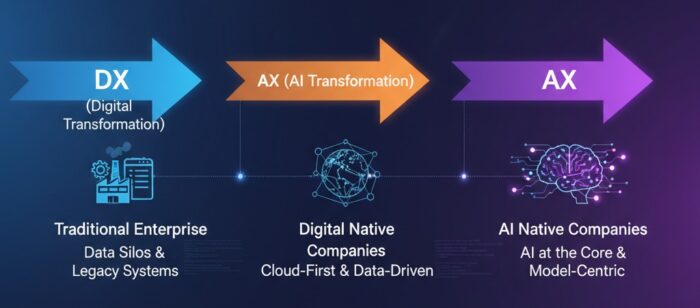
Introduction: The Shift from DX to AX
Over the past decade, Digital Transformation (DX) has reshaped the way organizations operate—digitizing workflows, migrating systems to the cloud, and improving customer connectivity. DX was about efficiency, modernization, and digital survival. But a new wave has arrived, and it’s far more transformative: AI Transformation (AX).
Beyond DX to AX: The Next Big Shift in Business Transformation
Unlike DX, which focused on digitizing existing processes, AX is about re-architecting business models around artificial intelligence (AI). It’s not merely a technology upgrade—it’s a strategic evolution redefining how value is created, delivered and sustained.
In industries ranging from finance to healthcare, manufacturing to retail, companies that once digitized to survive must now intelligently automate, predict and personalize to remain competitive. The underlying enablers? Data and AI.
Why AI Transformation Matters More Than Ever
AI Transformation isn’t just about adopting new tools—it’s about rethinking the business itself. Every function, from product design to marketing, is being reshaped by intelligent automation and predictive analytics.
Here’s how AI Transformation is redefining success across industries:
- Customer Experience → Hyper-personalized, real-time, AI-driven interactions that anticipate customer needs.
- Product Innovation → Smart, adaptive, and self-learning products that continuously evolve through data feedback.
- Operational Efficiency → Predictive automation that reduces waste, lowers costs, and enhances agility.
However, the path to AI Transformation (AX) varies widely depending on a company’s maturity. Let’s explore how three types of organizations—Traditional Enterprises, Digital Natives, and AI Natives—can each evolve to succeed in the AI era.
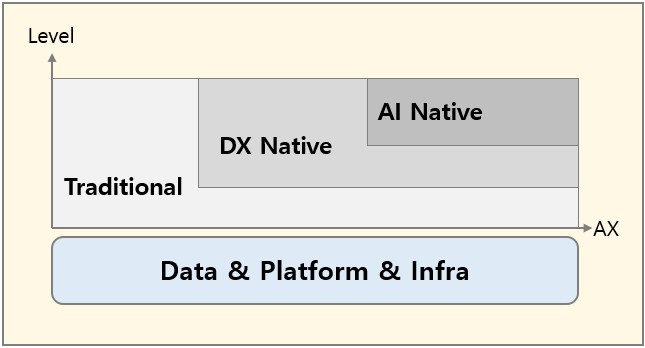
How Traditional Enterprises Can Truly Evolve Into AX Organizations
As digital transformation (DX) becomes a standard rather than a differentiator, a new competitive frontier has emerged: AI Transformation (AX). For years, DX helped organizations modernize—moving to the cloud, digitizing workflows, and improving operational efficiency. But AX represents a deeper shift. It’s not about using digital tools more effectively; it’s about reimagining the business around intelligence, prediction, and automation.
For traditional enterprises—banks, retailers, manufacturers, healthcare providers—the move from DX to AX can feel overwhelming. These companies often hold decades of data, complex processes, and deeply ingrained operating models. Yet, this legacy is also their biggest advantage—if they prepare correctly.
Below are the essential steps legacy organizations must take to evolve into true AX-driven companies.
1. Build Strategic Alignment Around AI at the Leadership Level
AX cannot succeed as a technology initiative alone—it must be a business strategy. Leaders must answer foundational questions:
- Where will AI create the most value for us?
- Which business outcomes matter most—customer experience, cost efficiency, or innovation?
- How will AI reshape our core products or services?
Without a clear vision and executive sponsorship, AI efforts stall as disconnected pilots with no measurable impact. AX starts when AI becomes central to the organization’s growth agenda—not an experimental side project.
2. Fix the Data Problem: Unify, Clean, and Govern
Legacy organizations rarely suffer from a lack of data. Instead, they struggle with fragmented, inconsistent, poorly governed data ecosystems:
- Siloed systems across departments
- Redundant or contradictory datasets
- Inconsistent formats and missing metadata
- Limited lineage and unclear ownership
- Overly restrictive access controls that slow innovation
Before advanced AI capabilities can truly take root, companies need to strengthen the foundation beneath them. This begins with building enterprise-level data platforms that bring all critical information together in one place. It also requires establishing governance frameworks that ensure data is accurate, consistent, and responsibly managed. Just as important are metadata and lineage standards, which allow teams to understand where their data comes from and trust the information they rely on for decision-making.
3. Invest in Scalable AI Infrastructure and Operating Models
Traditional enterprises often treat AI development like software development—manual deployments, slow iteration cycles, and fragile experimentation environments. AX demands something more modern:
- MLOps for automated training, deployment, and monitoring
- AIOps for operational intelligence across infrastructure
- Reusable feature stores, model registries, and pipelines
- Secure environments for sensitive enterprise data
These capabilities allow AI systems to improve continuously, not just during annual upgrade cycles. In AX companies, models evolve as quickly as the business itself.
4. Start With High-Value, Measurable Use Cases
AX doesn’t require companies to modernize every legacy system before getting started. Instead, traditional enterprises should focus on a small number of high-impact, high-visibility use cases that can quickly prove the value of AI. Examples include predictive maintenance in manufacturing, personalized customer engagement in banking or retail, automated claims processing in insurance, and advanced forecasting models for supply chains.
When organizations deliver these early wins, they gain credibility across the business, which in turn helps attract the investment, talent, and support needed to pursue larger and more ambitious AX initiatives.
5. Build AI Literacy and Cross-Functional Collaboration
AI transformation succeeds only when employees understand and trust the technology. To make this possible, traditional enterprises need to invest in building organizational capability and confidence. This includes training non-technical staff in the basics of AI, forming cross-functional teams that bring together IT, business, data, and operations, and creating an environment where experimentation is encouraged rather than feared. Companies must also establish an AI governance board to provide ethical oversight and ensure responsible use of AI across the organization.
Ultimately, culture becomes the defining factor—distinguishing organizations that merely talk about AI from those that truly harness it to create meaningful impact.
For traditional enterprises, transforming into an AX organization requires more than modern tools. It demands a rethinking of strategy, data foundations, infrastructure, and culture. The companies that win in the AX era will be those that take bold steps today—aligning leadership around AI, investing in data readiness, and demonstrating early value through targeted, high-impact use cases.
How DX Companies Must Evolve to Become True AX Organizations
Digital-native companies—those that were born in the cloud, built their products around data, and operate with modern engineering practices—have enjoyed a decade of competitive advantage. Their ability to personalize experiences, scale quickly, and iterate on products made them the stars of the DX era. But the landscape has changed. In an AI-driven economy, being digital is no longer enough. The next phase of transformation requires these companies to evolve into AI-first organizations, where intelligence becomes the operating system of the business.
So what exactly must digital-native companies prepare as they shift from DX to AX?
1. Build Real-Time Intelligence, Not Just Real-Time Data
Most digital-native companies already collect large volumes of data. However, AX demands more than data richness—it requires real-time intelligence. This means moving from dashboards and batch analytics to streaming insights that guide decisions as events unfold.
For example, instead of analyzing user behavior at the end of the day, AX companies use streaming analytics to personalize the customer experience the moment a behavior changes. The competitive edge lies not in how much data you capture, but in how fast your systems can interpret and act on it.
This shift often requires upgrading architecture: event-driven pipelines, low-latency data platforms, and ML models capable of serving predictions within milliseconds.
2. Commit to Continuous AI Experimentation
In DX, companies could afford longer release cycles. In AX, the pace of learning becomes the new moat. AI-first companies treat experimentation as a continuous discipline:
- Live A/B tests running constantly
- Automated model retraining based on fresh data
- Closed-loop feedback systems that update features and predictions
- Rapid iteration instead of big-bang releases
This experimental mindset allows organizations to improve models weekly—or even daily. AX maturity is measured not only by model performance, but by how quickly those models can evolve.
3. Embed Responsible AI From Day One
As AI becomes the engine behind decisions—recommendations, pricing, personalization, fraud detection—digital-native companies must prioritize trust, fairness, and transparency. Responsible AI is no longer a compliance checkbox; it is a core component of brand integrity.
AX companies take responsibility seriously, building structures and systems that ensure their AI operates safely and ethically. They develop clear governance frameworks that define how data should be used, and they invest in tools designed to detect and reduce bias in their models. Just as important, they create AI systems that are transparent and explainable so customers and regulators can understand how decisions are made. All of this is supported by privacy-first architectures that safeguard user rights and maintain trust.
Failing here can threaten customer trust and even business continuity.
4. Move From “Digital-First” to “AI-First” as the Operating Model
The biggest shift isn’t technological—it’s organizational. DX companies must redefine their identity. Instead of treating AI as a project owned by data teams, they must treat it as the default mode of operation:
- AI embedded in every product and workflow
- Cross-functional teams that combine engineering, data science, and product
- Leaders who understand AI’s strategic impact
- Company-wide literacy that empowers employees to use AI responsibly
DX helped companies scale and innovate quickly. AX will determine which of them lead the next decade. Those that invest in real-time intelligence, continuous experimentation, and responsible AI will gain a decisive competitive advantage. Those that don’t risk becoming “digital but outdated” as AI-native competitors accelerate ahead.
In the AX era, speed, intelligence, and trust aren’t just capabilities—they’re survival factors.
What AI-Native Companies Must Prepare to Execute AX Successfully
AI-native companies stand in a unique position within the modern business landscape. Unlike traditional enterprises or even digital-native firms, these organizations don’t simply use AI—they are AI. Their value proposition, customer experience, and competitive moat are built directly on the performance, trustworthiness, and scalability of their AI systems. Whether they develop generative AI platforms, autonomous technologies, or enterprise AI solutions, the challenge is the same: how to scale responsibly, reliably, and profitably in an increasingly demanding AX era.
Scaling AI is no longer about building impressive models. It’s about building sustainable businesses around those models. And to do that, AI-native companies must focus on several critical preparation areas.
1. Commercialization Must Be Intentional, Not Accidental
AI-native companies often excel technically but struggle commercially. Building a sophisticated model doesn’t automatically translate into a viable business. To scale effectively, AI-native firms must design clear routes to monetization, whether through API-based usage models, embedded AI features within existing platforms, industry-specific solutions, or enterprise-grade licensing agreements.
What matters most is delivering AI-powered experiences at scale—experiences that are reliable, differentiated, and able to create recurring value. Without a solid commercialization strategy, even state-of-the-art AI systems risk becoming expensive demos.
2. AI Must Be Embedded Deeply, Not Layered Superficially
In AX companies, AI is not treated as an optional feature—it’s embedded deeply into the core architecture of the product. This allows AI to guide real-time decision-making, power personalized or even autonomous behaviors, and continuously refine the product as new data becomes available.
AI-native firms must architect systems so that intelligence is not a feature—it’s the foundation. Products should evolve dynamically, learning from user interaction and scaling their intelligence over time.
3. Ecosystem Expansion Is the Path to Scale
No AI system can scale on its own. To grow effectively, companies need to build strong ecosystems that include APIs, integration layers, developer platforms, and strategic partnerships that encourage adoption. With these elements in place, AI solutions can plug seamlessly into enterprise environments, expand into new industries and use cases, and evolve more quickly through constant feedback from partners.
An AI model with no ecosystem is like a powerful engine without a vehicle—it has potential but no ability to move.
4. Data Quality and Access Define the Upper Limit of AI Performance
In AI-native businesses, data is far more than a resource—it is the lifeblood of the entire operation. To scale safely and maintain accuracy, organizations must ensure they have access to large volumes of high-quality, diverse data, along with clear rights and licensing frameworks that govern how that data can be used. Strong governance and lineage tracking are essential to maintain integrity and trust, while privacy-centric architectures must be built in from the start to protect users and comply with evolving regulations.
A model can only be as good as the data it learns from. Without disciplined data operations, model performance eventually plateaus or drifts.
5. Automate Every Part of the Model Lifecycle
As AI-native companies expand, relying on manual workflows quickly becomes a limiting factor. Successfully scaling AX requires end-to-end automation across the entire model lifecycle. This includes automating model training, implementing continuous deployment and versioning, monitoring models in real time for drift, bias, and performance degradation, and establishing automatic rollback and retraining processes to ensure models remain accurate and reliable as they evolve.
This ensures models improve continuously—without disrupting customer experience.
6. Ethics, Safety, and Explainability Are Competitive Advantages
For AI-native firms, responsibility must be built in from the start rather than treated as an afterthought. As AI increasingly influences decisions, behaviors, and outcomes, both customers and regulators expect systems that are transparent, with clear reasoning behind model outputs. Organizations must implement safeguards to prevent harmful results, strategies to detect and mitigate bias, and rigorous safety evaluations—including red team testing—to ensure their AI operates reliably and ethically.
Trust is the currency of the AI era. Companies that ignore responsibility will face adoption barriers, legal risks, and reputational damage.
For AI-native organizations—and for startups that aspire to become one—AX success depends on aligning technology, operations, ethics, and strategy into one cohesive system.
The Future of Business: When AI Becomes the Core
The transition from Digital Transformation (DX) to AI Transformation (AX) marks a fundamental shift in how organizations operate and compete. DX helped businesses go digital. AX helps them become intelligent.
Each type of company faces unique challenges, but they share one undeniable truth: AI and data are no longer support functions—they are the essence of business itself.
In summary:
- Traditional enterprises must unify data and build scalable AI operations.
- Digital Natives need to evolve toward real-time, responsible AI ecosystems.
- AI Natives must focus on trust, scalability, and monetization of their AI capabilities.
The future of business will belong to organizations that master this transformation. The question is no longer whether to adopt AI—but how quickly and intelligently your organization can evolve to lead in an AI-driven economy.