
Introduction
When organizations contemplate introducing AI, the usual vision revolves around enhancing a single domain — like automating customer support, boosting marketing metrics, or streamlining developer workflows. These AI-driven improvements deliver clear value, but very often they remain confined within a specific team or function. What many companies overlook is a more powerful, structural transformation: changing how work itself is done across the entire organization. That’s where common-task AI agents come into play.
Common-task AI agents have the potential not just to optimize one department, but to rewire the entire company’s workflow — saving time, reducing redundant effort, and elevating overall productivity.
What Are Common-Task AI Agents — and What Makes Them Different?
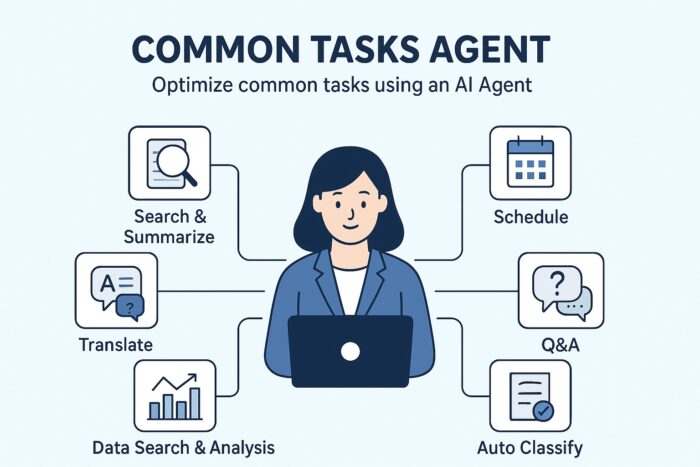
A common-task AI agent is an AI system that automates the everyday, repetitive tasks that virtually every employee performs — regardless of role or department. Unlike traditional AI adoption strategies which target isolated workflows (e.g. “AI for customer support chatbots” or “AI to assist developers”), common-task agents are universal helpers embedded across an entire organization.
Imagine a company where:
- Meeting notes are automatically summarized.
- Internal documents, training manuals, or past reports are searchable and retrievable in seconds.
- Multilingual teams get real-time translation and interpretation.
- Personnel across teams can query databases using natural language (e.g., “What were last month’s sales by region?”) — without needing SQL or a data-specialist.
- Emails, documents, or tickets are auto-classified and routed.
These are not niche tasks; they are part of the daily rhythm of many employees. When an AI agent takes over these chores, the productivity gains are felt company-wide — not just in one corner.
The power of automation lies in scale. As more people use the same task automation, the return on investment multiplies. Small time savings per person rapidly add up to hours, days — or even weeks — of saved work.
Real-World Uses: Common-Task Agents in Action
Many forward-looking companies are already deploying common-task AI agents in ways that significantly reshape how work gets done. Below are some of the most impactful examples.
1. Search & Summary Agents — Knowledge at Your Fingertips
Internal documents, onboarding guides, old project reports — companies accumulate massive amounts of knowledge over time. But often, that information becomes siloed, buried, or difficult to retrieve.
Enter search-and-summary agents: AI assistants that scan internal knowledge bases, find relevant documents or clauses, and deliver concise summaries. The result? Employees spend far less time digging through folders or emails and more time acting on insights. Onboarding becomes faster, data reuse increases, and redundant work is minimized.
Especially for large enterprises or those with distributed teams, this shift can dramatically reduce overhead: what once took hours may now take seconds.
2. Translation & Real-Time Interpretation Agents — Breaking Language Barriers
In global companies or companies with remote teams across regions, language can become a hidden productivity barrier. Real-time translation agents — either translating documents or providing live interpretation during meetings — turn multilingual chaos into seamless collaboration.
What used to require hiring freelance translators or manually translating documents is now done instantly. Cross-border teams can sync faster, reduce human translation cost, and dramatically improve speed and clarity.
3. Data Query & Database Access Agents — Empowering Non-Technical Teams
Many internal data tasks — pulling sales numbers, tracking campaign performance, analyzing customer churn — have historically fallen to data analysts or engineers. Even simple data retrieval often requires SQL queries or specialized knowledge.
But with agents that support natural-language-to-database (NL2SQL) queries, anyone can get the data they need with a simple request. For example:
- “Show me last quarter’s revenue by product line.”
- “Compare this month’s marketing campaign CTR across regions.”
- “List top 10 customers by purchase volume in the last 6 months.”
The democratization of data access reduces bottlenecks, empowers teams, and accelerates decision-making — without waiting for a data team to step in.
4. Auto-Classification Agents — Smarter Organization, Less Manual Work
Emails, tickets, documents — these often require classification (by type, project, priority, department). Historically, this meant manual sorting or relying on simple keyword-based automation.
With AI-powered auto-classification, however, classification becomes more accurate and faster. Emails get routed to the right team, customer support issues are triaged automatically, compliance-related documents are flagged correctly, and internal requests get sent to the right department.
Not only does this reduce manual workload, but it also increases consistency and reduces human error — particularly important for compliance, support, and HR workflows.
5. Other Emerging Use Cases
Beyond the above, common-task agents are also being used for:
- Automated schedule management and meeting coordination
- Meeting-note generation and distribution
- Internal policy Q&A (e.g. “What’s our legal policy?”)
- HR service agents responding to recurring inquiries
- Workflow routing and approval automation
In many modern companies, what once were back-office chores are slowly being handled by AI — quietly, efficiently, and across the board.
What It Takes: Preparing Your Company for Common-Task Agents
Adopting common-task AI agents is not just a technical project. For success, companies need a foundation. Here are the most important steps:
1. Identify Suitable Tasks Strategically
Begin with tasks that:
- Are widely used by many or all employees
- Are repetitive and time-consuming
- Yield standardized, consistent outputs
- Show clear potential for time or cost savings when automated
By focusing on high-impact, low-complexity tasks, companies can ensure quick wins and build momentum.
2. Standardize Workflows and Processes
If each team or department handles similar tasks differently, it becomes difficult for an agent to learn or operate consistently. Standardizing procedures — naming conventions, folder structures, documentation formats — helps ensure agents perform reliably and deliver quality results.
3. Build a Robust Technical Infrastructure
Common-task agents must integrate with existing systems — internal databases, document storage, communication tools, and more. According to leading enterprise AI vendors like Samsung SDS, effective AI agent deployment requires seamless connectivity, access control, and a secure environment. (Source: Samsung SDS)
Additionally, proper permission management (who can access what), logging, and governance are essential to prevent data leaks or unauthorized usage.
4. Clean, Organized, and Accessible Data — The Lifeblood of Effective Agents
Arguably the most critical requirement: internal data (documents, manuals, files, records) must be well-organized, version-controlled, and consistently formatted.
When data is messy, outdated, or scattered, search and summary agents struggle to deliver accurate results. Teams waste time verifying outputs or dealing with errors. A clean, unified knowledge base isn’t a luxury — it’s a necessity.
Standardized terminology, file naming conventions, and unified document formats help agents “understand” your organization’s content better, increasing both accuracy and trustworthiness.
What’s Next? Looking Ahead for Common-Task Agents
Multi-Agent Collaboration & Workflow Automation
In the near future, we’re likely to see multiple agents collaborating to complete complex, multi-step tasks. For example: imagine telling the system: “Prepare a weekly sales report for Monday’s meeting.”
Behind the scenes:
- A search agent pulls relevant sales and marketing data.
- An analysis agent computes key metrics and trends.
- A summarization agent writes a brief overview.
- A document-generation agent compiles everything into a ready-to-share report.
This kind of end-to-end automation — from data retrieval to final output — will drastically cut down manual work and speed up reporting cycles.
Autonomous “Digital Employees” — Not Just Tools, but Colleagues
As Agentic AI matures, these agents won’t just respond to requests — they’ll proactively identify inefficiencies, propose improvements, and even autonomously take action (within safe, controlled boundaries).
Think of them not as tools, but as digital co-workers. For many businesses, that could mean transforming operational workflows, unleashing human creativity, and allowing staff to focus on strategic, high-value work.
Recommendations: How to Start Implementing Common-Task Agents
If you’re a business leader, manager, or tech lead thinking about adopting common-task AI agents, here’s a suggested roadmap:
- Audit daily workflows: List all repetitive tasks employees do regularly. Which ones are common across many teams? Which are time-consuming but offer little strategic value?
- Prioritize tasks for automation: Start with tasks that are high impact, low complexity, and widely used.
- Clean up your internal data: Standardize folder structures, document templates, naming conventions; remove outdated or duplicate content.
- Build or integrate infrastructure: Ensure you have a secure LLM platform, system integrations, permission controls, and logging.
- Pilot with a small team or department: Test the agent on a limited scope before scaling — refine workflows, gather feedback, and measure time saved or errors reduced.
- Scale gradually but strategically: Once trust and efficacy are built, roll out across more teams. Use analytics to track ROI, usage rates, and impact on productivity.
- Establish governance and human-in-the-loop checks: For important decisions — data exports, sensitive content access, compliance — require human oversight or approval.
Conclusion
Common-task AI agents represent more than just a new tech trend. They embody a fundamental shift in how organizations can operate: moving from manual, fragmented tasks to unified, automated workflows; from siloed departments to company-wide efficiency; from reactive reporting to real-time insight.
When repetitive, low-value work is handled by AI, human employees are freed up to do what humans do best: creative thinking, strategic planning, innovation, and human-centric collaboration.
In a world where digital transformation and data-driven decision-making increasingly define competitive edge, adopting common-task AI agents is not just a smart move — it’s becoming essential.
If you’re leading a company or team, consider this more than an AI pilot. Think of it as organizational evolution — the first step toward becoming a truly smart, agile, and future-ready company.