
Introduction
As artificial intelligence adoption accelerates across industries, expectations continue to rise that AI will eventually handle most tasks intelligently and autonomously. From customer support and content generation to analytics and decision-making systems, AI is increasingly visible in everyday business operations.
Yet the reality is more complex. AI does not become effective simply because models grow more powerful. For AI to work well in real organizations, humans must first build the environment in which AI can succeed.
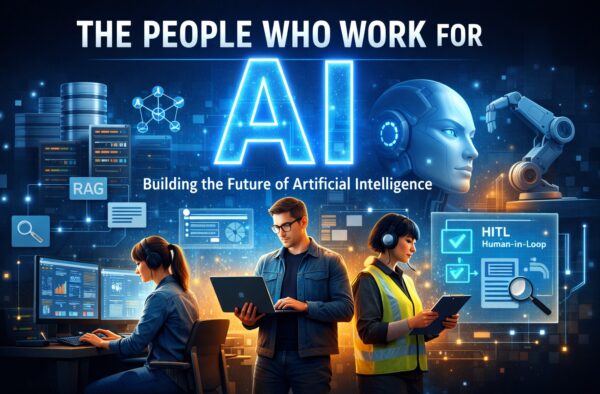
I call these professionals “the people who work for AI.”
They are not trying to replace humans with machines. Instead, they make it possible for machines to become reliable partners in human work.
Their contribution can be understood through three essential roles: preparing data that AI can understand, building pathways for AI to access that data, and creating systems to validate and take responsibility for AI’s outputs.
1. The People Who Prepare Data That AI Can Understand
The most fundamental—and often most underestimated—task in AI is transforming raw data into something AI can interpret meaningfully. This work goes far beyond improving data quality or fixing missing values.
Data must be standardized and structured so that AI can process it consistently. Metadata must be added to explain what each piece of data means, where it comes from, and how it should be used. At the same time, business rules and decision criteria must be clearly defined so that AI does not operate in a vacuum without organizational context.
Even more challenging is the task of converting domain knowledge and human experience into structured information. In many organizations, critical knowledge exists only in the heads of experienced workers. AI cannot learn from intuition alone; that knowledge must be documented, categorized, and formalized.
This creates an interesting paradox. The smarter we want AI to be, the more human effort is required upfront to design and organize its inputs.
One of the most overlooked aspects of this role is turning tacit knowledge into explicit knowledge. Consider a hospital setting. A senior radiologist may know that certain image distortions usually indicate equipment issues rather than medical abnormalities. If that understanding is never written into labeling guidelines or metadata definitions, an AI system may misclassify cases and create risk rather than value.
To support AI properly, people must translate expertise into structured systems of meaning. This role typically involves:
- Defining data standards and taxonomies
- Creating metadata frameworks that describe context and intent
- Encoding business rules and domain knowledge into machine-readable formats
In the AI era, data management, metadata design, and knowledge structuring are no longer background IT functions. They are strategic foundations for intelligent systems.
2. The People Who Build Pathways for AI to Access Data
Even the best-prepared data is useless if AI cannot reach it. The second major role is designing the pathways that allow AI to access the right data at the right time.
This work includes integrating data scattered across departments, connecting different systems, and creating efficient retrieval mechanisms. Increasingly, modern AI systems rely on Retrieval-Augmented Generation (RAG), which allows models to pull information from internal knowledge bases instead of depending only on what they learned during training.
However, AI cannot design its own information ecosystem. Humans must decide which data sources are authoritative, which versions are current, and who is allowed to access each dataset.
In many organizations, data fragmentation remains a major obstacle. Marketing may rely on one customer database, finance on another, and operations on a third. Without coordination, AI systems can retrieve inconsistent or outdated information, leading to unreliable outputs.
The people who work in this role focus on designing systems that answer three core questions: what AI can access, when it can access it, and under what conditions. Their responsibilities usually include:
- Integrating multiple data sources into unified pipelines
- Designing knowledge bases and search structures for RAG systems
- Managing version control so AI always uses the most current information
- Creating permission and security frameworks
These decisions shape how trustworthy AI can be. If humans do not design clear pathways, AI will navigate chaos. In this sense, AI infrastructure is not only engineering; it is human-centered architecture.
3. The People Who Validate and Take Responsibility for AI Results
The third role may be the most critical: designing systems of validation and feedback.
AI outputs are probabilistic by nature. They can be wrong, biased, or incomplete. For that reason, any serious AI deployment must include processes for verification and correction.
This is where the concept of Human-in-the-Loop (HITL) becomes essential. HITL defines where humans intervene, how results are reviewed, and how feedback improves future performance. It is not about slowing AI down but about ensuring reliability and accountability.
The importance of this role becomes obvious in high-stakes environments. If an AI system recommends a medical treatment, screens job applicants, or flags financial fraud, errors can have serious legal and ethical consequences.
Regulatory trends show that this responsibility is increasingly formalized. For example, the European Commission’s AI Act classifies certain systems as high risk and requires human oversight, transparency, and auditability. Similarly, in healthcare and finance, regulators demand that humans remain responsible for final decisions even when AI is involved.
As a result, new professional roles are emerging, including AI quality managers, trust and safety specialists, and model auditors. These professionals focus on ensuring that AI systems behave as intended and that organizations can explain and defend their decisions.
Their work often includes:
- Designing checkpoints where human review is required
- Monitoring performance and detecting bias or drift
- Creating feedback loops to improve system behavior
- Assigning responsibility when errors occur
This highlights an important insight: deciding what AI should automate and what humans must approve is not just a technical design choice. It is a question of governance and accountability.
Conclusion
Using AI effectively matters. But building the foundations that allow AI to work properly matters even more.
One day, AI may reach a point where it can solve problems independently. Until that threshold is reached, the role of people who prepare, guide, and supervise AI remains essential.
Our task today is not to replace ourselves with AI. It is to create the conditions in which AI can work safely and productively.
The true competitive advantage in the AI era does not come from adopting the newest model or the largest dataset. It comes from investing in the people who design the environment around AI—those who organize data, build access pathways, and create systems of trust.
In that sense, the future will belong not to those who merely use AI, but to those who understand how to make AI work.
Key Takeaways
The success of AI depends on three human-centered roles:
- Data Preparation Specialists who structure data, define metadata, and translate domain knowledge into machine-readable form
- Data Access Architects who integrate systems, design retrieval pathways, and manage security and versions
- AI Validation and Trust Designers who build Human-in-the-Loop processes and ensure accountability and safety
In the age of automation, intelligence may come from machines—but meaning, responsibility, and trust still come from humans.
The people who work for AI are, ultimately, the people who make AI work for everyone else.