
Introduction: Why Action Matters in AI Transformation
In business, as in life, waiting for perfect conditions often leads to missed opportunities. The same principle applies to AI Transformation (AX). Many organizations hesitate to adopt AI because they believe their data, infrastructure, or workforce readiness is not perfect. While preparation is important, early action and incremental progress often produce better results than waiting for perfection.
AX is a journey, not a one-time implementation. Companies that start small, focus on meaningful use cases, and scale strategically tend to achieve faster adoption, higher ROI, and stronger organizational support.
Start Small, Scale Smart: How Businesses Should Apply AI for Real Impact
As companies race to adopt AI, many leaders feel pressure to launch large, high-visibility initiatives right away. But in practice, the organizations that succeed with AI almost always follow a different path: they start small, build momentum, and expand only after early wins. This approach not only reduces risk, but also helps the business develop the internal capabilities—data infrastructure, governance, and organizational alignment—needed for long-term impact.
The smartest companies don’t chase the biggest or most complex use case first. Instead, they choose small, well-defined projects that align directly with business strategy. These early use cases should be narrow enough to deliver quick results but meaningful enough to prove value. Examples include automating a specific report, improving a micro-conversion in the customer journey, or reducing manual work in a single workflow.
By starting small, teams gain hands-on experience, understand real data limitations, and begin shaping the internal processes required for AI operations.
Each small use case becomes a building block. As the organization accumulates wins, it naturally strengthens its data pipelines, governance framework, model deployment processes, and cross-functional collaboration. This incremental growth creates a stable environment for more sophisticated AI applications later.
Once the foundation is in place, the business can confidently move toward larger, enterprise-level initiatives—such as predictive demand forecasting, automated decision systems, or AI-driven personalization at scale. At this stage, the company is no longer experimenting; it is executing strategically.
Starting with small, strategically aligned use cases allows companies to learn quickly, mitigate risk, and build the right environment for AI. Then, scaling to big use cases becomes not only possible but effective—directly contributing to measurable business performance.
Why Starting Small Matters
Think of beginning your AI journey like starting a fitness routine. Some people wait until they own all the gear, have detailed training plans and free time; others simply put on running shoes and begin, improving over time. The key difference is momentum and consistency.
When applied to an AI program, the “start small” principle allows organisations to:
- Gain early insights into AI capabilities
- Minimize financial and operational risk
- Build organisational confidence in AI initiatives
Rather than spending years building costly infrastructure before delivering any tangible proof, starting with focused, manageable pilot projects helps businesses learn fast, adjust strategy and deliver measurable value.
Applying the “Start Small” Principle to AX
Organizations often approach AI adoption with a massive rollout plan—designing enterprise-wide infrastructure, gathering extensive datasets, and preparing elaborate training programs. While thorough, this method delays actual results, risks executive disengagement, and may overextend resources.
In contrast, a use‑case‑first strategy invites a more agile, focused approach:
- Begin by selecting one or two high‑value use‑cases in a particular department or workflow.
- Gather just enough data to test these use‑cases, avoiding a full‑scale data‑warehouse build upfront.
- Run fast experiments, analyse outcomes, iterate based on findings, and then expand.
This method offers multiple advantages:
- Faster feedback loops: By testing small, you can adjust direction early before committing larger budgets.
- Lower risk: You avoid making substantial investments on initiatives that may not yet pay off.
- Executive buy‑in: Leadership sees tangible outcomes quickly, boosting support for further rollout.
From Small Wins to Bigger Challenges
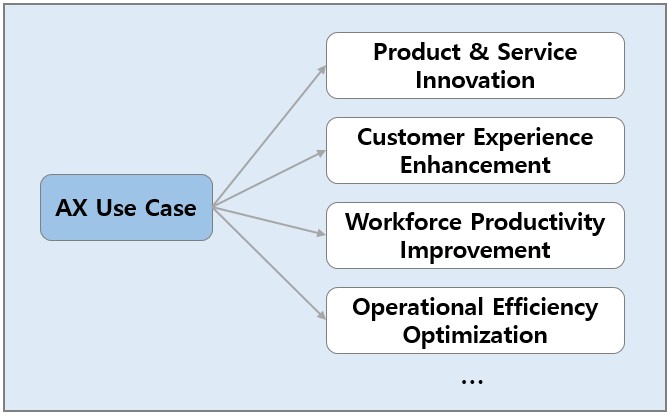
Not all AI initiatives are created equal. If you’ve started by tackling small AI projects and seen positive results, it’s time to scale up and apply AI to bigger, more strategic challenges. Focus on use‑cases that are strategic, measurable, and align with business goals. To identify these:
- Look for urgent problems: customer experience challenges, high error or defect rates, process bottlenecks.
- Seek transformational opportunities: e.g., launching new AI‑driven services, automating complex workflows, or creating entirely new business models.
- Target high‑impact internal processes: areas where productivity improvement translates into significant savings or revenue.
Focusing on the “right” use‑cases ensures early efforts generate tangible results, build momentum and align with overall business strategy.
To expand AI initiatives, the following are essential:
- Replicating successful use cases across departments or regions
- Investing in data infrastructure and AI platforms that support enterprise-wide operations
- Maintaining governance and ethical standards for AI deployment
- Tracking KPIs consistently to ensure ongoing value
Scaling is not about expanding every project at once. It’s about selective, strategic growth , building on proven success while managing risk and resources effectively.
Measuring Success: Quantify Everything
A major factor in successful AX adoption is the ability to show measurable outcomes. Leaders and stakeholders respond most effectively when they can clearly see the impact in numbers. That impact can come from both direct and indirect results.
On the direct side, improvements often show up as revenue increases, cost reductions, or even a reduced need for outsourcing. Indirect outcomes are just as important and may include time savings from automation, higher productivity, and better employee satisfaction.
Whenever it’s possible, translating these results into actual dollar values makes the story even stronger. Putting a financial figure behind the impact not only adds credibility but also helps secure executive buy-in. Ultimately, demonstrating clear, quantifiable results creates the momentum needed to scale AI initiatives across the entire organization.
Building Organizational Buy-In
Even when an AI project is technically successful, it can still fall short if the organization isn’t fully behind it. That’s why it’s crucial to demonstrate the value of AI early and often. Showing quick wins within your teams helps build momentum and earns trust from both executives and employees.
One of the most effective ways to do this is by sharing early successes—and even the lessons learned from challenges—across the organization. When people see real examples, they begin to understand how AI can support their own work. Involving cross-functional teams in pilot projects also helps create a sense of ownership. When team members participate directly, they’re far more likely to champion the initiative rather than resist it.
Just as important is fostering a culture that embraces experimentation and iteration. AI is rarely perfect in its first version, and organizations that treat early projects as learning opportunities tend to evolve much faster.
By celebrating measurable wins and openly discussing setbacks, companies build credibility and confidence. This transparency not only strengthens internal alignment but also paves the way for wider adoption of AI across departments. Over time, these small cultural shifts make AI feel less like a technical project and more like a shared organizational capability.
AI Transformation provides substantial benefits for both the organization and its workforce.
For the organization:
- Increased operational efficiency through automation and smarter decision‑making.
- Cost reductions via optimized workflows and fewer manual errors.
- New revenue opportunities: e.g., personalized services, AI‑driven products, new market segments.
- Competitive advantage—even in fast‑changing markets.
For employees:
- Reduced manual, repetitive tasks enable focus on strategic, high‑value work.
- Collaboration with AI tools elevates skill sets and expertise.
- Improved job satisfaction and engagement as roles shift from routine to meaningful.
Final Thoughts: Start Small, Expand Big
The most successful AI Transformation programs begin with small, manageable initiatives while maintaining a strategic vision. They start by identifying meaningful and measurable use cases, ensuring that each project has clear objectives and potential impact. These initiatives are executed quickly, with iterative adjustments made to demonstrate early results. By showcasing these wins, organizations can secure buy-in from leadership and stakeholders, building momentum for broader adoption. Finally, successful programs scale AI initiatives strategically across the enterprise, expanding proven solutions to maximize overall business value.
In AX, speed, adaptability, and learning by doing are just as important as technology itself. The sooner organizations begin taking small, deliberate steps, the sooner they unlock tangible business value. Don’t wait for perfect conditions. Start small, measure results, and expand strategically to transform your business with AI.