

Introduction
As enterprises increasingly embrace artificial intelligence (AI), one key question keeps emerging: How much does AI actually improve productivity? Understanding this is critical because AI-driven productivity directly influences competitiveness, operational efficiency, decision-making, innovation speed, and cost reduction.
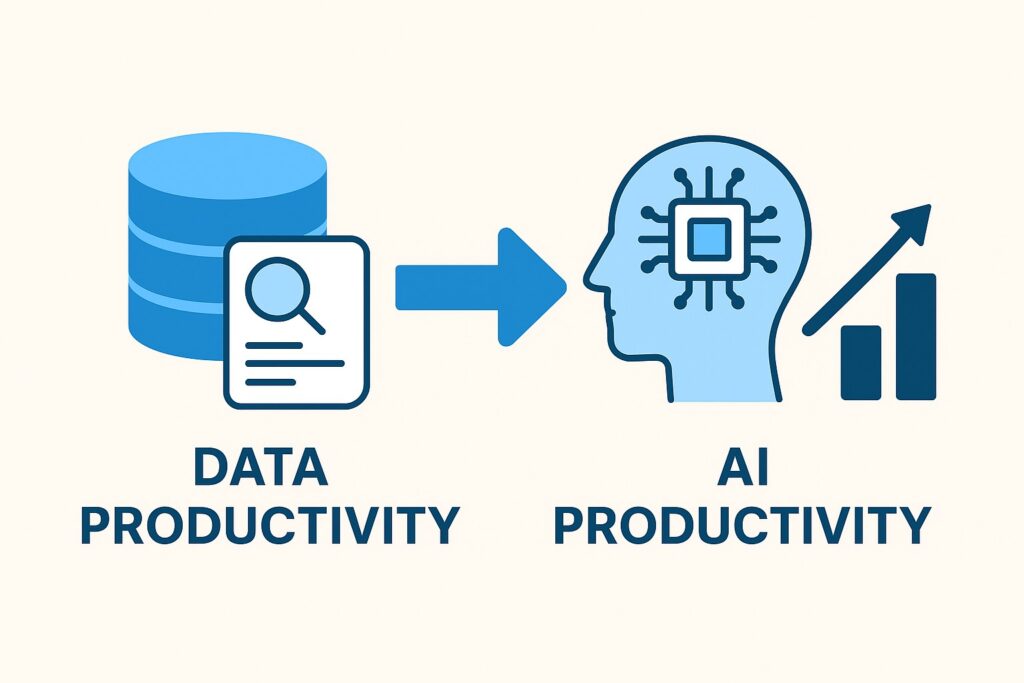
The foundation of AI productivity lies in data productivity. In fact, data productivity is what fuels and accelerates AI productivity. When organizations measure and manage data productivity through clear, quantifiable metrics, they can enhance not only the quality of their data but also the performance of their AI systems. In this sense, AI productivity and data productivity are deeply interconnected—each reinforcing the other.
How AI Boosts Productivity
AI enhances productivity in several fundamental ways:
- Automating repetitive and time‑consuming tasks, freeing employees to focus on more strategic and creative work.
- Processing large amounts of data in real time, enabling faster and more accurate decision‑making.
- Supporting personalized services, identifying emerging opportunities, and helping businesses predict and respond to market shifts more effectively.
When implemented strategically, these capabilities lead to lower operational costs, higher return on investment (ROI), and greater agility in an increasingly competitive market.
A key takeaway here is that AI’s value is magnified when paired with the right data foundation. It’s not simply “we have AI” but “we have AI supported by high‑quality, well‑governed, usable data.”
How to Measure AI Productivity
To measure AI productivity effectively, organizations must consider both quantitative and qualitative dimensions.
Quantitative Metrics
Quantitative indicators reflect measurable aspects of business performance and operational efficiency. These metrics help organizations objectively evaluate the real impact of AI initiatives. Examples include:
- Task-completion speed and automation rates: For instance, measuring how much faster customer-support tickets are processed after introducing an AI-assisted workflow, or tracking the percentage of repetitive tasks that are now fully automated compared to manual handling.
- Cost savings generated through AI deployment: This may involve calculating reductions in labor hours, lower infrastructure or maintenance costs, or savings from preventing downtime using predictive analytics.
- Error reduction and measurable improvements in process efficiency: For example, comparing error rates before and after implementing AI-driven quality checks in a manufacturing line, or evaluating how automated data validation reduces financial-reporting mistakes.
- Return on Investment (ROI) from AI-related projects: This includes assessing how quickly an AI solution pays for itself through increased revenue, operational savings, or productivity gains. For instance, a marketing optimization model might deliver more ROI by increasing conversion rates without increasing ad spend.
These metrics reveal how AI contributes to tangible outcomes such as faster operations, reduced costs, and improved accuracy.
Qualitative Metrics
Qualitative metrics, on the other hand, assess how AI adoption influences people, innovation, and the broader business culture. These indicators help leaders understand changes that numbers alone can’t fully capture. Examples include:
- Employee satisfaction and how automation empowers staff to focus on more meaningful work: For example, teams may report feeling less overwhelmed when AI handles repetitive data entry, allowing them to spend more time on problem-solving, strategy, or customer-facing activities.
- Customer experience improvements, such as more personalized or efficient service: This might include customers noting faster response times from AI-assisted support centers, or expressing that recommendations feel more relevant and tailored to their preferences. Companies can track feedback from customer interviews, NPS comments, or social listening to understand sentiment shifts after implementing conversational AI or personalization engines.
- Contributions to innovation, including the ability to launch new products or services faster: For instance, AI-driven prototyping tools might enable product teams to iterate quickly, reducing weeks of manual analysis down to days. A company may find that AI accelerates experimentation—such as A/B testing, product simulations, or market analysis—leading to more frequent product updates and faster entry into new markets.
By combining both types of metrics, organizations can gain a holistic view of AI productivity, encompassing not just what AI does, but how it transforms the way people and businesses operate.
Why Data Productivity Matters
Behind every successful AI system lies a foundation of well‑managed, high‑quality data. In fact, even when companies have massive datasets and advanced platforms, they often fail to generate value because data alone does not create impact—its productivity does.
Data productivity can be thought of as the engine behind both digital transformation (DX) and AI transformation (AX). The stronger the data foundation, the stronger the AI outcomes.
While comprehensive statistics on ‘data productivity’ are still limited, one striking indicator is the notion of ‘dark data.’ IBM estimates that about 90% of data produced by sensors and analog-to-digital conversions goes unused. (Source: Eurescom)
Even with massive data volumes, the productivity of that data (i.e., how much of it is usable, timely, and leveraged for business impact) matters far more than sheer volume.
Measuring Data Productivity
Just as AI productivity depends on outcomes, data productivity depends on how efficiently data flows through its lifecycle—from collection to utilization. To assess it, businesses should examine the following four dimensions:
1. Policy and Process
Data productivity starts with clear and flexible policies that support AI adoption. Strong data governance frameworks—policies that are consistent, transparent, and able to adapt quickly to new regulations or organizational changes—are foundational.
Example:
A global firm that reduces data access request turnaround from weeks to hours by introducing a self‑service data catalog and automated approval process will boost data productivity. Such a transformation might reduce “time to insight”.
2. Data Collection
Effective AI depends on accurate and relevant data. Organizations should evaluate whether their data collection processes are efficient, reliable, and aligned with current business needs. This includes maintaining up‑to‑date data pipelines and ensuring collection methods meet ethical, regulatory, and operational standards.
Example:
Suppose a retail chain tracks point‑of‑sale data from 500 stores in real time—previously, data arrived next day. By upgrading to streaming ingestion, the chain can reduce latency from 24 h to near‑real time, increasing data freshness and thus productivity.
3. Data Management
Once data is collected, it must be organized and maintained for AI usability. This means things like applying metadata, labeling, and structure so that data can be easily accessed and analyzed. High‑quality management also means maintaining cost‑effective, scalable data platforms that can handle large workloads while preserving data accuracy.
Example:
A company that transitions from multiple unmanaged Excel files to a unified data lake with defined schema, catalog, and metadata can significantly reduce duplicate data sets and save substantial time in finding and cleaning data.
4. Data Utilization
Finally, productivity is realized when data is actually used. That means tracking how extensively data is utilized across AI projects, whether those projects deliver measurable results, and how quickly insights are turned into business action.
Example:
A logistics provider measures how many data‑driven insights from their fleet system actually resulted in business decisions (for example, route changes, fuel savings). If only 10 % of insights lead to action, utilization is low — improving that rate (e.g., to 30 %) is a measure of improved data productivity.
Measuring data productivity isn’t just a “nice to have”—it surfaces how mature your data ecosystem is, and reveals where bottlenecks or waste lie (for example, unused data, slow pipeline turnaround, poor governance).
The Link Between Data and AI Productivity
The connection between data productivity and AI productivity is direct and powerful. When organizations manage data effectively—ensuring its quality, accessibility, and strategic use—they naturally improve AI performance.
Better data leads to more accurate models, faster innovation, and more confident decision-making. In other words, data productivity amplifies AI productivity.
Organizations that consistently measure and optimize their data processes tend to experience several meaningful advantages:
- Higher AI ROI, as models produce more reliable insights: For example, when data pipelines are cleaned, standardized, and continuously monitored, machine-learning models suffer fewer errors and require less retraining. This means a sales-forecasting model might stay accurate for longer periods, reducing operational costs and delivering consistently actionable predictions.
- Faster innovation, driven by real-time data access and analysis: Teams can experiment more quickly when fresh, trustworthy data is always available. A product team, for instance, may launch new feature prototypes weekly—rather than monthly—because they can instantly analyze user behavior and test ideas without waiting for batch reports.
- Enhanced decision-making, based on trustworthy information: Leaders are less likely to rely on gut feelings when dashboards reflect accurate, up-to-date data. A retail manager might adjust inventory levels in response to real-time sales trends, preventing stockouts or over-ordering, all because the underlying data ecosystem is dependable.
- A stronger competitive advantage, fueled by smarter and more agile operations: Over time, organizations that treat data as a managed, measurable asset tend to outperform peers. For example, a logistics company may route deliveries more efficiently using continuously optimized data workflows, allowing them to offer faster shipping at lower cost—something competitors struggle to match.
Conversely, businesses that neglect data management risk stagnation. Without efficient data pipelines or quality standards, AI systems may produce unreliable outputs, reduce trust, and waste resources.
The Future of AI-Driven Productivity
In the age of digital transformation, AI productivity will increasingly depend on data productivity. The companies that build strong, measurable, and adaptive data foundations will see the greatest returns from AI adoption.
The future isn’t just about implementing AI—it’s about operationalizing it through smarter data practices. As data quality, accessibility, and governance improve, so too will AI’s ability to deliver real business value.
In today’s AI-driven economy, investing in data productivity isn’t optional—it’s essential. Enterprises that master the synergy between data and AI productivity will lead the next wave of innovation, achieving greater efficiency, agility, and long-term growth.
Final Thoughts & Action Steps
- Audit your data lifecycle: From collection to utilization, map out where the bottlenecks are in the four dimensions of data productivity.
- Define metrics: Choose a few measurable indicators (e.g., data‑to‑insight time, percentage of usable data assets, number of AI projects delivering ROI) and track them.
- Link data metrics to AI outcomes: For every AI initiative, trace back to the underlying data foundations—ask: Was the data ready? Was it utilized? What prevented it from being used?
- Iterate & improve: Use real results to refine your data policies, pipelines, and utilization practices.
By doing this, you’ll shift from “We have AI” to “We use AI effectively,” and from “We collect data” to “We exploit data productively.” That’s where real business impact lies.