
Introduction
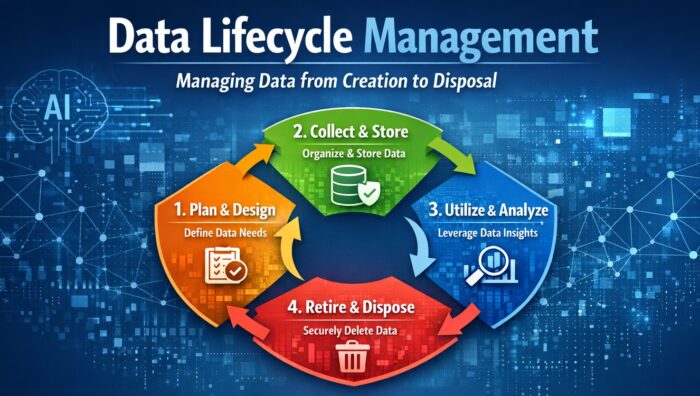
In every organization today, data is constantly being created, processed, reused, and eventually discarded. Much like people experience birth, growth, maturity, and end of life, data follows its own journey from creation to disposal. This journey is known as the data lifecycle, and the discipline of managing it end-to-end is called Data Lifecycle Management (DLM).
At a glance, data lifecycle management may seem like a technical or operational concern. In reality, it is a strategic capability that directly affects business performance, regulatory compliance, and the success of AI and analytics initiatives. As organizations move beyond traditional digital transformation and into the era of AI Transformation (AX), the importance of managing data across its entire lifecycle has never been greater.
What Is the Data Lifecycle?
At its core, the data lifecycle describes the end-to-end journey of data within an organization. This journey begins when data requirements are defined and continues as data is collected, stored, used, analyzed, retained, and eventually deleted. Rather than viewing these activities as isolated tasks owned by different teams, the data lifecycle frames them as a continuous and connected flow.
Data Lifecycle Management refers to the discipline of managing these stages as a unified system. When planning, collection, utilization, and disposal are treated as part of a single lifecycle, organizations gain better control, stronger accountability, and clearer insight into how data creates value. This holistic perspective distinguishes true data lifecycle management from fragmented data operations that focus only on storage or analytics in isolation.
Why This Matters
In the AX era, data quality and structure directly influence the accuracy, reliability, and trustworthiness of AI models. Poorly governed data leads to biased insights, unstable predictions, and a loss of confidence among users and stakeholders. Without disciplined lifecycle practices, AI initiatives are far more likely to fail—and those failures can be expensive.
Gartner has warned that more than 60 percent of organizations will struggle to realize the expected value of their AI investments due to weak data governance and lifecycle management. (Source: Gartner) This insight highlights a critical reality: AI success is fundamentally a data management challenge. Effective data lifecycle practices are no longer a technical nice-to-have but a strategic requirement for sustained competitiveness.
Despite significant investments in data platforms, many organizations still cannot clearly explain what data they have, where it resides, or how it is being used. This confusion typically arises when lifecycle stages are managed independently, without a shared framework or visibility across the organization. Over time, this fragmented approach leads to inefficiencies, rising storage costs, compliance gaps, and wasted investment.
Data lifecycle management addresses these issues by improving transparency and control. When data is consistently logged, classified, and tracked across its lifecycle, decision-makers gain a clearer understanding of their data landscape. They can see which datasets exist, who is using them, and for what purpose. This visibility reduces duplication, eliminates shadow data, and helps organizations avoid unnecessary storage and operational costs.
Beyond visibility, lifecycle management enables a shift toward value-based data utilization. Not all data contributes equally to business outcomes. By understanding usage patterns, organizations can identify which datasets actively support analytics, operations, or AI models, and which ones have become dormant or obsolete. This insight is essential for measuring data ROI and making informed investment decisions.
Security and compliance further elevate the importance of lifecycle management. Regulations such as GDPR, HIPAA, and CCPA impose strict requirements on how data is stored, retained, and deleted. Without structured lifecycle controls, organizations risk keeping data longer than allowed, misusing sensitive information, or failing audits—issues that can result in significant legal and financial penalties. A strong lifecycle framework enforces retention policies, audit trails, and secure disposal practices, reducing risk while building trust with customers and regulators.
Stages of the Data Lifecycle: What They Mean
The data lifecycle can be understood through a series of interconnected stages, each of which plays a critical role in ensuring data remains valuable, secure, and compliant throughout its existence.
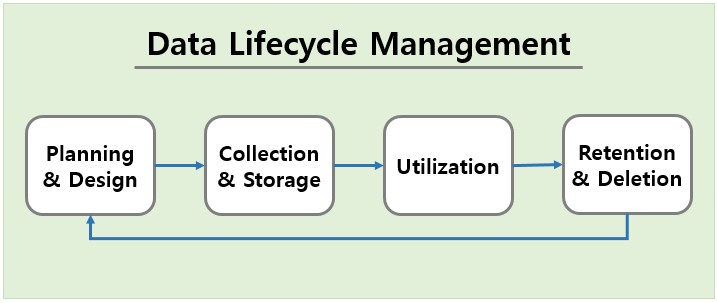
1. Planning & Design: The Foundation of Good Data
The planning and design stage is often overlooked, yet it sets the direction for the entire lifecycle. During this phase, organizations define what data is required for specific business use cases, such as reporting, analytics, or AI model development. They also determine key attributes, metadata standards, quality expectations, and security or compliance constraints.
When planning is inadequate, problems quickly emerge downstream. Data may be collected without clear purpose, quality may be inconsistent, and teams may need to redo work at significant cost. In AI projects, weak planning frequently results in models trained on incomplete or biased datasets, reinforcing the well-known “Garbage In, Garbage Out”. Strong lifecycle management treats data planning as a strategic activity aligned with business goals, not as an afterthought.
2. Collection & Storage: Controlled Ingestion and Classification
Once data requirements are defined, data is collected from a wide range of sources, including applications, cloud services, sensors, and user interactions. At this stage, the challenge is not just ingestion, but ensuring data is stored in a structured and well-classified manner.
Accurate tagging, clear differentiation between raw and derived data, and traceability of data origin are all essential. A disciplined approach prevents uncontrolled data sprawl, improves searchability, and supports trustworthy analytics. Many modern DLM systems also optimize storage by automatically moving inactive data to lower-cost tiers while keeping frequently accessed data readily available.
3. Utilization: Where Data Becomes Insight
Data delivers real value when it is actively used to support decisions, automate processes, or train AI models. During the utilization stage, data flows into dashboards, operational systems, and machine learning pipelines.
However, understanding data usage is just as important as the data itself. By tracking how often datasets are accessed, who uses them, and for what purpose, organizations gain insight into which data truly matters. These insights inform better storage strategies and guide future data design decisions. Real-time usage analytics also create feedback loops, allowing lessons learned from utilization to improve data quality, collection methods, and governance policies over time.
4. Retention & Deletion: Completing the Lifecycle
Although data is a valuable asset, it is not meant to be stored indefinitely. Over time, data may lose relevance, exceed its retention period, or become subject to deletion due to changes in customer consent or regulatory requirements. Lifecycle management ensures that data is archived or securely disposed of at the appropriate time.
Effective disposal extends beyond central repositories. Data must also be removed from analytics environments, backups, and downstream systems to fully eliminate risk. Keeping outdated or unnecessary data increases storage costs, security exposure, and compliance risk. Properly managing this final stage completes the lifecycle and reinforces accountability.
Building an Effective Data Lifecycle Framework
Turning data lifecycle management into an operational reality requires more than isolated tools or policies. Organizations must standardize metadata and lifecycle rules so that context travels with the data wherever it goes. Automation and AI-enabled tools can continuously track lineage, usage, and quality at scale, reducing manual effort and error. Compliance requirements should be embedded directly into lifecycle workflows, ensuring that retention and deletion happen consistently and defensibly. Finally, insights from data usage should feed back into planning and collection processes, creating a continuous improvement loop that strengthens the entire lifecycle over time.
Conclusion
As businesses face increasing data volumes, stricter regulations, and growing reliance on AI, data lifecycle management has become a foundational capability rather than a technical afterthought. Organizations that master it are better positioned to extract value from data while controlling cost and risk.
In the end, success in the AX era is not about having more data. It is about managing data intelligently across its entire lifecycle, ensuring that every dataset serves a purpose, delivers value, and exits the organization responsibly when its role is complete.