
When we talk about data today, the discussion often centres around Big Data and Small Data—the massive datasets powering AI models, and the more targeted, often user‑level data used to personalize experiences.
Big Data vs. Small Data: Why Both Matter in the Age of AI
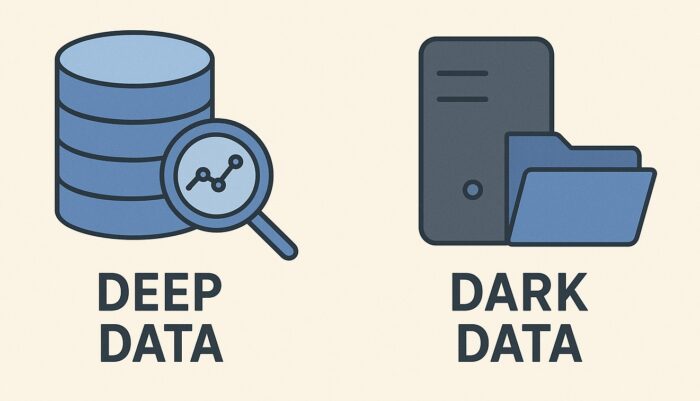
But beyond these familiar terms lie two less‑talked‑about yet hugely significant forms of data: Deep Data and Dark Data. Though the words “deep” and “dark” may sound esoteric or ominous, they in fact represent powerful opportunities for organisations that know how to harness them.
While Big Data provides scale, and Small Data enables personalization, Deep Data and Dark Data serve as the hidden layers of insight: one offering depth, precision and clarity; the other representing untapped, often neglected potential. Organisations that learn to identify and activate these layers can gain a substantial competitive edge.
What Is Deep Data?
“Deep Data” refers to high‑quality, highly detailed, often hard‑to‑collect information that offers specific, actionable insights rather than just broad trends. Unlike datasets used simply to observe surface behavior, Deep Data dives into the fine details that influence outcomes strategically.
Real‑world examples of Deep Data
- Consumer – Appliance usage: Most home‑appliances manufacturer tracks actual usage cycles, error logs, inverter run‑times, and ambient conditions for devices used in households. With this information, the company predicts when units will reach end‑of‑life, optimizes warranty offers and tailors replacement marketing campaigns.
- B2B – Manufacturing/distribution: A manufacturer collects detailed distributor‑sales records, delivery and installation logs, and service‑call histories. By analyzing these, the company locates operational inefficiencies (for example, in particular regions), fine‑tunes logistics routes, and improves customer satisfaction.
- Healthcare: A hospital integrates diagnostic histories, treatment outcomes and even genetic profiles. With high‑quality, domain‑specific data, doctors and administrators refine diagnostic protocols, tailor therapies and manage care pathways more efficiently.
Key characteristics of Deep Data
- It is defined by accuracy and precision, rather than sheer volume.
- It typically requires domain expertise, cross‑departmental integration and advanced analytics tools to interpret properly.
- Unlike surface‑level metrics (e.g., monthly sales totals), Deep Data helps answer the “why” behind business outcomes, not just the “what”.
- Because of its depth, it is more common in B2B industries or complex operational environments where fine‑grained processes matter.
When organisations move from intuition‑based decision‑making to evidence‑based intelligence, Deep Data becomes the foundation. It enables smarter strategy, sustainable growth and what we might call precision strategy—for example, zeroing in on a specific segment where the lifetime value is highest, or identifying the minute defect‑pattern that causes 80% of returns.
When you see a “mystery” or consistent under‑performance in a process, ask: What dataset have we not drilled into yet? The answer often lies in Deep Data.
What Is Dark Data?
If Deep Data shines light on the hidden layers of insight, Dark Data represents the opposite — data that remains in the shadows.
Dark Data refers to information that companies already collect and store but fail to use effectively. It is often described as the idle portion of Big Data: vast, unstructured, and often forgotten.
Why Dark Data Exists
ChatGPT의 말:
Data often accumulates in organizations for several common reasons. Many companies collect information under the assumption that “we might need it someday,” without defining a clear use case for it. Additionally, much of the data is unstructured, such as old email archives, server logs, or IoT telemetry, and lacks clean, accessible metadata, making it difficult to manage. Finally, data processing and cleaning can seem too expensive or complex, leading to large volumes of information sitting idle and unused.
A global survey conducted by Splunk of 1,300+ business/IT decision‑makers found that 60 % of organisations believed that half or more of their organisation’s data qualifies as dark. A full one‑third reported that 75 % or more of their data is dark. (Source: IBM)
These numbers highlight a major paradox: Organizations are collecting more data than ever, but most of it remains unused—incurring cost and risk, and missing potential value.
Challenges and Considerations
- Storage of unused data still costs money (whether on‑premises or in the cloud).
- Dark Data can create liability: privacy/regulation risks, security breaches, compliance exposures.
- Simply having the data isn’t enough—it must be accessible, searchable and used. The key challenge: transforming Dark Data from a liability into a competitive asset.
Start by mapping where your organisation accumulates data but rarely analyses it. Common “dark” zones: archived logs, older customer‑service records, IoT telemetry sitting unprocessed, untagged documents. Ask: What questions could this data answer if cleaned? Pulling even one unexpected insight—perhaps a recurring customer complaint pattern hidden in old tickets—can unlock value.
Why Deep Data and Dark Data Matter
While it’s tempting to focus only on Big Data (volume) or Small Data (personalization), the real frontier of data strategy lies in the interplay of four dimensions: Big, Small, Deep and Dark. As one thought‑leader puts it: Big Data provides the macro‑view, Small Data customizes at the micro‑level, Deep Data brings accuracy and precision, and Dark Data holds untapped discovery potential.
The business case
The business case for leveraging Deep and Dark Data lies in enhancing strategic decision-making. By using Deep Data, companies can move beyond asking “What happened?” to understanding “Why did it happen, and what actions should we take?” Activating Dark Data allows organizations to uncover hidden patterns and relationships that traditional analyses might miss, creating opportunities for new products, untapped market segments, operational efficiencies, and overall growth. Combining better-quality input from Deep Data with the broader insights from Dark Data improves AI models and analytics, as context-rich, relevant training data leads to more accurate predictions. In today’s environment, where data collection is nearly commoditized, the true differentiator is intelligent data use—how effectively an organization integrates, governs, analyzes, and acts upon all types of data, rather than merely how much data it accumulates.
Practical steps for organisations
- Audit your data estate: Catalog what you collect, store and ignore. Tag what’s “cold” or “untouched”.
- Prioritize by value and cost: Identify where Deep Data could most improve business decisions (e.g., high‑value customer cohorts, complex operational processes) and where Dark Data poses risk or hidden opportunity.
- Establish data governance: Without good metadata, data catalog, clear ownership and searchable systems, both Deep and Dark Data will remain under‑utilized.
- Use analytics tools thoughtfully: For example, combining descriptive/diagnostic analytics (what/why) with predictive/prescriptive analytics (what next/how) works better when you have rich Deep Data and when you reclaim Dark Data. According to IBM, big data analytics uses descriptive, diagnostic, predictive and prescriptive methods. (Source: IBM)
- Measure return on data: For example, track how many new insights or revenue‑generating actions resulted from “re‑activated” Dark Data, or how decision‑making improved with Deep Data.
Beyond Big and Small Data
The future of data-driven business intelligence will no longer be measured solely by the volume of data an organization collects. Instead, success will hinge on how intelligently every type of data is utilized. Organizations that excel at integrating Deep Data—high-quality, context-rich information—and activating Dark Data—the untapped, hidden datasets—can transform passive information into actionable intelligence.
This approach enables more precise and informed decision-making, delivers personalized and proactive customer experiences, supports smarter operational design, and drives sustainable strategic growth.
Ultimately, the companies that master this intelligent use of data will not only anticipate future trends but actively shape the business landscape of tomorrow.
Conclusion
In today’s data‑rich world, the biggest gap is no longer access. It’s insight. Every enterprise collects data—but few exploit the full value of what lies beneath the surface. By consciously recognizing Deep Data as a strategic asset and Dark Data as an untapped pool of opportunity, you shift from being data‑rich but insight‑poor to being insight‑rich and strategically agile.
If you’re building a data‑strategy roadmap, make sure you ask not just “What data do we have?”, but “What data are we not using?” and “What deeper stories can our data tell?” Doing so may be the difference between surviving and thriving in an AI‑driven future.