
Introduction
AI transformation (AX) is not simply about deploying flashy tools—it’s about moving from isolated pilots to a scaled, company‑wide engine of intelligence. Without a structured AX development framework, businesses risk fragmented data, disconnected AI models, overloaded operational costs, and minimal business impact.
A comprehensive AX framework enables AI systems to be scalable, sustainable, and business‑value driven. Below, we explore the key layers of such a framework and provide guidance you can act on.
Why a Structured AX Framework Matters
Deploying advanced AI tools is only part of the story. A structured AX framework gives organizations a significant competitive edge. It ensures that AI initiatives can scale without chaos, maintain governance and security, continuously improve through feedback loops, and consistently deliver value both internally and for customers.
Think of it as laying tracks before running the train: with a solid framework, each new AI use‑case can be implemented faster, more reliably, and with higher impact.
When talking to executives or stakeholders, frame the AX initiative not just as “we’ll build models” but as “we’re building a growth engine”. This shifts thinking from experimentation to business continuity, from “pilot” to “program”.
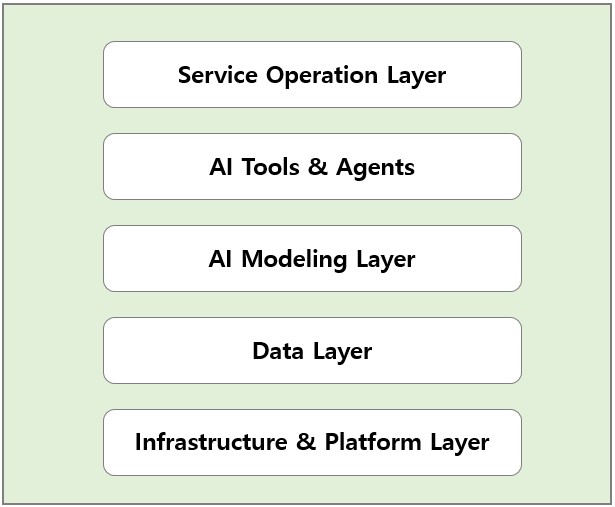
Architecture of the AX Development Framework
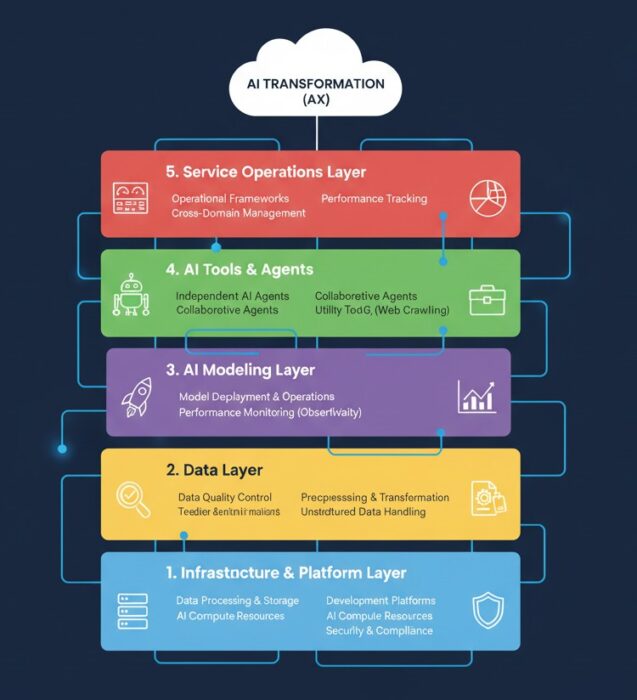
1. Infrastructure & Platform Layer – The Foundation
Every successful AI initiative rests on a robust infrastructure and platform layer. Whether operating on cloud, on‑premises, or hybrid architectures, this layer serves as the backbone for data management, model training and deployment.
Key components include
- Data processing & storage:
Raw data must be ingested, cleaned and stored in centralized repositories (data lakes, enterprise data warehouses). - Development platforms:
These integrate with the data systems and provide workflows tailored to specific use‑cases (e.g., model training pipelines, feature stores). - AI compute resources:
Deployment of large models (such as GPT, Gemini, LLaMA) often needs high‑performance GPUs, cloud clusters or edge resources. - Security & compliance:
Protecting sensitive data, establishing robust access controls, and meeting regulatory requirements (e.g., GDPR, HIPAA) is non‑negotiable.
A weak infrastructure layer means fragmentation—multiple data silos, disjointed model deployments, and scaling issues. With a solid foundation, each new AI use‑case can “plug in” more easily, reducing overhead and risk.
Many companies underestimate this layer because the visible part of AI is the model or agent—but the hidden plumbing often determines whether the initiative succeeds or stalls. Investing in infrastructure upfront can shorten time‑to‑value rather than drag it out.
2. Data Layer – Transforming Raw Data Into AI-Ready Fuel
This layer is the heart of AI transformation. Even the most advanced model can perform poorly if fed poor or unstructured data.
Best practices for this layer
- Data quality control:
Ensure data is clean, consistent, and reliable (e.g., minimal missing values, correct labels). - Pre‑processing & transformation:
For example, normalization, tokenization, feature engineering. For image/audio/text data, proper formatting is critical. - Metadata management:
Document datasets—what they contain, how they were collected, how they relate—to help with context, reuse, and lineage. - Unstructured data handling:
Documents, images, audio files often lie unused. Organizing them (with tagging, indexing, embedding) makes them usable for AI models.
Case in point: According to a recent report, about 78 % of organizations reported using AI in at least one business function in 2024—up from 55 % the year prior. (Source: McKinsey) Moreover, the same data shows that smaller firms lag behind large ones in data governance and scaling practices. This underlines how essential the data layer is—if the data is messy, you cannot scale AI reliably.
Treat your data layer not just as a one‑time setup, but as an ongoing discipline—monitoring data drift, retraining, annotating new data, and maintaining metadata. That maintenance work is often overlooked.
3. AI Modeling Layer – Turning Data Into Actionable Intelligence
Once data is ready, it’s time for models. But modeling isn’t just building a neural network—it’s deploying, monitoring, and maintaining it.
Key components
- Model development:
Training and optimizing models that address real business problems (not just research toys). - Model deployment & operations (“MLOps”/LLMOps):
Version control, packaging, infrastructure for inference, continuous delivery of models. - Performance monitoring & observability:
Track metrics such as accuracy, drift, latency, resource usage; understand when models degrade or misbehave.
Research indicates that only ~1 % of companies consider themselves “mature” in AI deployment (i.e., AI is fully integrated into workflows). (Source: McKinsey)
This suggests many businesses get stuck at pilot or point‑solution level, failing to embed AI into core operations.
Think of modeling as a lifecycle, not a one‑time build. From experimentation → production → monitoring → retraining, you need a clear lifecycle. Without it, you risk “model decay” and lost ROI.
4. AI Tools & Agents – Turning Models Into Real-World Impact
Models alone don’t deliver value. They need to be exposed via tools, agents and workflows that human teams or customers can use.
Typical examples
- Independent AI agents:
For example, an agent that auto‑generates meeting minutes from raw meeting transcripts. - Collaborative agents:
Multiple agents coordinate—for instance: agent A parses new documents, agent B extracts actionable items, agent C updates dashboards. - Utility tools:
Retrieval‑Augmented Generation (RAG) setups, web crawlers, document parsers, chatbots, virtual assistants.
These tools translate intelligence (the model output) into actionable workflows. Without them, models may sit idle or be used manually, reducing business leverage.
Consider designing for user experience early. If front‑line teams cannot easily use the agent/tool, adoption will stall. Build interfaces (UI, APIs) and consider change management as much as the technical build.
5. Service Operations Layer – Maintaining Performance and Stability
Building and deploying are one thing — maintaining performance and stability at scale is another. This layer ensures that your AI initiatives remain sustainable across business units and over time.
Key responsibilities
- Operational frameworks:
Standardize processes for running models/services (e.g., incident management, version rollback, service‑level metrics). - Performance tracking:
Measure ROI, business impact, model accuracy, operational cost—then optimize. - Cross‑domain management:
As AI initiatives multiply, coordination across data science, IT, legal, business units becomes essential.
Don’t treat operations as afterthought. Define KPIs early (“number of models in production”, “percentage of use‐cases re‑used”, “business value delivered”), track them, and build the culture of continuous improvement.
Practical Insights for Implementing AX Successfully
As organizations move into the era of AI Transformation (AX), many discover that adopting AI is not simply a matter of installing new tools or running a few experimental pilots. Instead, effective AX requires a thoughtful, structured approach that aligns technology, strategy, data, and people. While every organization is different, several fundamental principles consistently determine whether AI initiatives deliver real business value or become stalled experiments. The following insights provide a practical roadmap for companies aiming to implement AX successfully.
One of the most important steps is to begin with high-impact use cases that are directly connected to strategic business priorities. Companies often make the mistake of selecting AI projects because they seem trendy or technically interesting, only to discover that these pilots have little connection to measurable outcomes. A more effective approach is to choose use cases that clearly support top-level goals such as cost reduction, revenue growth, improved customer experience, or enhanced operational efficiency. When a use case is tied to a real business need, it becomes easier to justify investment, secure leadership support, and scale the solution across the organization. High-value use cases not only deliver early wins but also build momentum and confidence for broader transformation.
Centralizing data management is another essential element of AX success. AI models rely on clean, accurate, and accessible data, and fragmented data environments can derail even the strongest AI strategy. By consolidating data across departments and systems, organizations can reduce duplication, improve data reliability, and accelerate experimentation. Centralization also helps eliminate data silos, which remain one of the most common barriers to AI adoption. Research Report (Source: McKinsey’s State of AI) indicates that larger organizations with centralized AI governance and data strategies are more likely to scale AI successfully across the enterprise. When data becomes a shared strategic asset instead of a department-specific resource, the entire organization benefits.
Cross-functional collaboration is equally important. AX cannot be delivered by the IT department or data science team alone. Successful execution requires the coordinated effort of business units, operations teams, product owners, engineers, and analytics professionals. Data scientists may be able to build sophisticated models, but without business context, process knowledge, and operational readiness, those models will not translate into real value. Collaboration bridges these gaps and ensures that AI solutions are designed not just to perform well in theory but to work effectively in real-world environments.
Another critical mindset shift is planning for scale, not just pilot success. Many companies celebrate the completion of a single AI proof-of-concept (POC) but fail to move beyond the initial experiment. True AX requires organizations to transition from “one successful pilot” to “dozens of use cases deployed and scaled across multiple departments.” This shift involves monitoring metrics such as the rate of model reuse, time required to deploy new use cases, and the percentage of AI models that reach production. A scalable operating model is what ultimately separates AI-mature organizations from those stuck in perpetual pilot mode.
Continuous performance tracking and iteration also play a key role. Establishing clear KPIs early—such as model accuracy, the percentage of model drift, business value per model, or infrastructure cost per use case—allows organizations to refine their AI lifecycle over time. Regular evaluation ensures that models remain accurate, relevant, and financially justified as business conditions evolve.
Finally, strong governance and proactive risk management are essential as AI adoption expands. Issues such as algorithmic bias, data privacy, model explainability, and security must be addressed systematically. Without proper governance, AI initiatives can expose the organization to legal, ethical, or operational risks that undermine long-term success.
Conclusion: Turning AI Transformation Into a Business Engine
Successfully implementing AI transformation isn’t just about technology adoption. It requires a structured framework, clear processes, well‑defined roles and continuous improvement. From infrastructure → data → modeling → tools/agents → operations, each layer contributes to sustainable and scalable AI.
When done right, a strong AX framework enables businesses to accelerate innovation, improve efficiency, and deliver measurable value. AI transformation moves from being a set of disconnected projects to becoming a company‑wide engine for growth and competitiveness.
With the right foundation in place, organisations can scale AI with confidence, secure executive support, and ensure that every initiative contributes to long‑term business success.
If you treat AI as just another project, you’ll likely get project‑level outcomes. But if you treat AI as a transformation framework—with layered architecture, lifecycle discipline, governance, metrics, and scale—you build a capability that propels your organisation forward.