
Introduction
In an era where data is often described as “the new oil,” companies generate and collect massive volumes of information every day. Yet the true value of data does not lie in dashboards, reports, or storage systems. Its real purpose is to support better decisions — decisions that are faster, more consistent, and grounded in evidence rather than opinion.
In reality, however, many organizations still struggle to translate data insights into actual decisions. Faced with the same dataset, teams often arrive at different conclusions. In many cases, the final decision is influenced less by analytical rigor and more by seniority, intuition, or the most persuasive voice in the room. As a result, the objectivity and rationality that data promises are frequently underutilized.
This persistent gap between data analysis and decision execution is precisely where AI-driven decision making comes into play.
What Is AI-Driven Decision Making?
AI-driven decision making refers to a structural shift in how organizations make choices. Rather than using AI merely as an analytical tool that produces insights, companies embed AI directly into the decision-making process itself.
In this model, AI systems ingest large volumes of structured and unstructured data, interpret complex variables simultaneously, and generate not only insights but also recommended actions, potential outcomes, and trade-offs. In some clearly defined scenarios, AI can even execute decisions automatically within predefined rules and constraints.
This represents a fundamental transition. Traditional data-driven decision making still assumes that humans interpret analysis and decide what to do next. AI-driven decision making, by contrast, is about human-AI collaboration, where AI actively participates in shaping decisions based on business context, historical patterns, and real-time signals.
In short, organizations move from “decisions informed by data” to “decisions made with AI.”
Why AI-Driven Decision Making Matters
The strategic value of AI-driven decision making lies in three core advantages: consistency, speed, and scalability.
Human decision makers bring experience, intuition, and contextual understanding — qualities that remain irreplaceable. At the same time, humans are subject to cognitive biases, fatigue, and limitations in processing large amounts of information. AI complements these limitations by applying the same logic consistently, analyzing massive datasets in seconds, and identifying patterns that are difficult for humans to detect.
Because of these capabilities, AI-driven decision making is increasingly viewed not as a technical upgrade but as a strategic transformation of how organizations operate. Companies that successfully integrate AI into decision workflows often see improvements across multiple dimensions: better customer experiences, higher operational efficiency, reduced costs, and more resilient strategies in volatile markets.
How AI Is Already Changing Decisions in Practice
AI-driven decision making is no longer theoretical. Across industries, organizations are already using AI to influence high-impact decisions.
In the financial sector, major U.S. banks such as JPMorgan Chase and Wells Fargo have publicly stated that AI adoption has significantly improved operational productivity. (Source: Reuters) Executives report that AI systems help employees process information faster, prioritize actions more effectively, and make more consistent decisions at scale. These gains are not just about automation — they reflect improved decision quality in areas such as risk assessment, fraud detection, and customer engagement.
AI is also increasingly present in human resources decision making. Surveys indicate that a majority of managers now use AI tools to support decisions related to promotions, compensation adjustments, and workforce planning. While these applications raise important ethical and governance considerations, they underscore how deeply AI is penetrating decision processes that were once considered purely human.
These examples illustrate a broader trend: AI is becoming embedded in everyday business decisions, from operational choices to strategic planning.
A Deep Dive into AI-Driven Decision Architecture
One of the most frequently cited examples of enterprise-level AI decision systems is Palantir. Palantir positions its Foundry and Artificial Intelligence Platform (AIP) as more than analytics tools, describing them instead as an operating system for decision making within organizations. (Source: Palantir)
At the core of this approach is an ontology-based data structure. Rather than treating data as disconnected tables or metrics, ontology modeling represents data as real-world business entities — such as customers, orders, assets, suppliers, or risks — and explicitly defines the relationships between them. This allows AI systems to understand not just the data itself, but the business meaning behind it.
Because AI operates on a shared, enterprise-wide representation of reality, it can support decisions in a way that aligns with how the business actually functions. The result is not just faster analytics, but more coherent, context-aware decision support across departments.
This architectural approach highlights an important principle: AI-driven decision making depends as much on data structure and semantics as it does on advanced algorithms.
The Three Stages of AI Decision Maturity
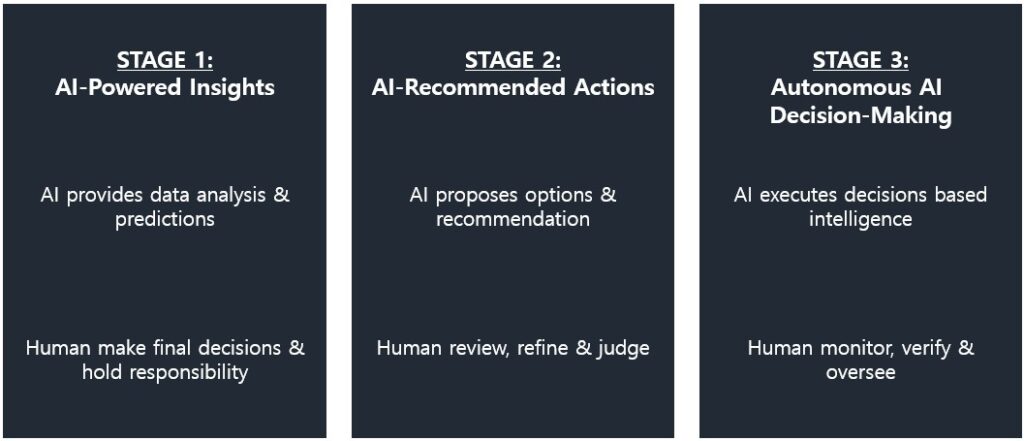
AI decision making does not happen overnight. For most organizations, it evolves gradually as data maturity, organizational trust, and operational confidence in AI increase over time. Rather than a single leap, companies typically move through three broad phases, each representing a deeper level of AI involvement in decision processes.
Stage 1: Insight and Recommendation
At the earliest stage, AI functions primarily as an advanced analytical engine. It processes large datasets, identifies patterns, and generates insights that would be difficult or time-consuming for humans to uncover on their own. However, the responsibility for interpreting those insights and making final decisions remains firmly with people.
In this phase, AI is often used to surface signals such as customer churn risk, demand fluctuations, or operational anomalies. For example, an AI model may identify customers who are likely to cancel a subscription, but marketing or customer success teams decide how — or whether — to intervene. This stage closely resembles traditional data-driven decision making, but with richer insights and stronger predictive capabilities.
Organizations often begin here because it allows teams to build trust in AI outputs without introducing significant risk.
Stage 2: Recommendation With Comparison
As confidence grows, AI moves beyond generating insights and begins to actively evaluate decision alternatives. At this stage, AI compares multiple options, models potential outcomes, and recommends a preferred course of action based on predefined objectives and constraints.
Humans still play a critical role by reviewing these recommendations, validating assumptions, and applying judgment — particularly when trade-offs or uncertainties are involved. For instance, AI may recommend optimal inventory levels by simulating different demand scenarios, while supply chain managers assess financial risk, supplier reliability, or market volatility before approving execution.
This phase is especially effective for repetitive, operational decisions where speed and consistency matter, yet human oversight remains essential to manage exceptions and edge cases.
Stage 3: Autonomous Decisions + Monitoring
In the most advanced phase, AI is trusted to make and execute decisions autonomously within clearly defined boundaries. These decisions typically occur in environments where rules are explicit, outcomes are measurable, and risks are well understood.
A common example is dynamic pricing, where AI systems continuously adjust prices in real time based on demand signals, inventory levels, competitor behavior, and customer response. Humans do not intervene in each individual decision, but instead monitor performance through dashboards, alerts, and governance metrics to ensure outcomes align with business objectives and ethical standards.
At this stage, the role of humans shifts from decision execution to oversight, exception handling, and continuous improvement. AI becomes an operational decision engine, while people remain accountable for strategy, governance, and long-term direction.
No single level of AI-driven decision making is inherently “best” for every organization. The appropriate degree of AI involvement depends on a company’s unique context, including its tolerance for operational and strategic risk, the maturity and reliability of its data assets, and the overall culture of the organization. In highly regulated industries or environments with strict compliance requirements, human oversight may remain central to decision making for longer periods. Conversely, organizations with strong data governance, high-quality datasets, and a culture that embraces experimentation may move more quickly toward deeper AI participation in decisions. Ultimately, successful adoption requires aligning AI capabilities with business realities rather than pursuing automation for its own sake.
Preparing for AI-Driven Decision Making
Successfully implementing AI-driven decision making requires deliberate preparation. Among all prerequisites, data readiness is the most critical.
First, organizations must ensure that their data is accurate, reliable, and consistently maintained. AI systems learn from historical data, and any errors, inconsistencies, or outdated information will directly affect the quality of AI-supported decisions. In practice, this means establishing clear data ownership, standardized definitions, and ongoing quality controls.
Second, companies need to move beyond fragmented, department-level datasets. AI performs best when it can see the full business context. This requires connecting data across functions and organizing it around core business entities such as customers, products, and processes. Ontology-based models play a key role here by enabling AI to reason across relationships rather than isolated variables.
Finally, AI-driven decision making must be supported by continuous feedback loops. Decisions should be measured, outcomes evaluated, and results compared against expectations. This feedback allows organizations to refine both their data and their AI models over time. As this cycle repeats, AI evolves from a static tool into a learning decision partner that becomes increasingly aligned with the organization’s goals and constraints.
Conclusion
AI-driven decision making is not simply about adopting advanced technology. It is about re-architecting how decisions are made within an organization. When data, processes, and organizational culture evolve together, AI can become a true operating layer for business decisions — supporting consistency, agility, and insight at scale.
As competitive pressure increases and business environments grow more complex, AI-driven decision making is shifting from an optional innovation to a strategic necessity. The companies that succeed will not be those with the most AI tools, but those that most effectively integrate AI into the way decisions actually happen.