
Generative AI, AI agents, recommendation systems, document intelligence platforms, and conversational AI services are rapidly transforming how digital products are built. Companies across nearly every industry are investing heavily in AI-driven services in hopes of improving productivity, automating workflows, and creating entirely new customer experiences. However, despite the growing excitement around artificial intelligence, many AI projects still experience unexpected setbacks once development moves beyond the prototype stage.
One of the biggest reasons for this is that many organizations still approach AI product development using the same mindset as traditional software development. In many projects, AI is treated as an additional feature layered on top of an existing product rather than a fundamentally different type of system that requires its own operational structure, governance model, and continuous learning process.
As projects move closer to deployment, teams often begin encountering problems that were not visible during the early development phase. Data dependency issues, inconsistent model behavior, performance disagreements between stakeholders, operational limitations, and user trust concerns frequently emerge late in the project lifecycle. In many cases, these problems lead to delays, increased costs, redesigns, or even major changes in product direction.
I have personally experienced these challenges while working on both structured-data AI projects and unstructured document-based AI systems. Although the business goals and technical environments were different, the underlying problems were surprisingly similar.
Most AI product development processes generally follow a familiar sequence: planning, data collection and processing, model training, validation, deployment, and operations. However, in real-world projects, the most serious difficulties are often not caused by the AI model itself. Instead, they result from failing to fully consider the operational and organizational characteristics unique to AI systems.
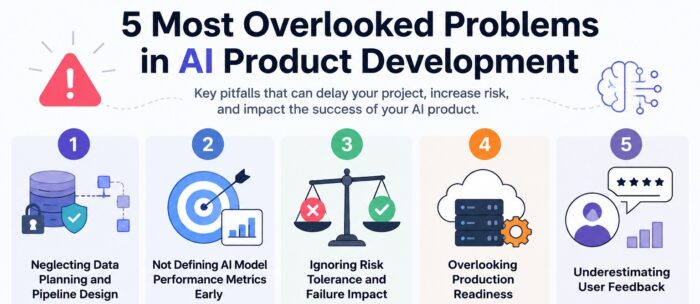
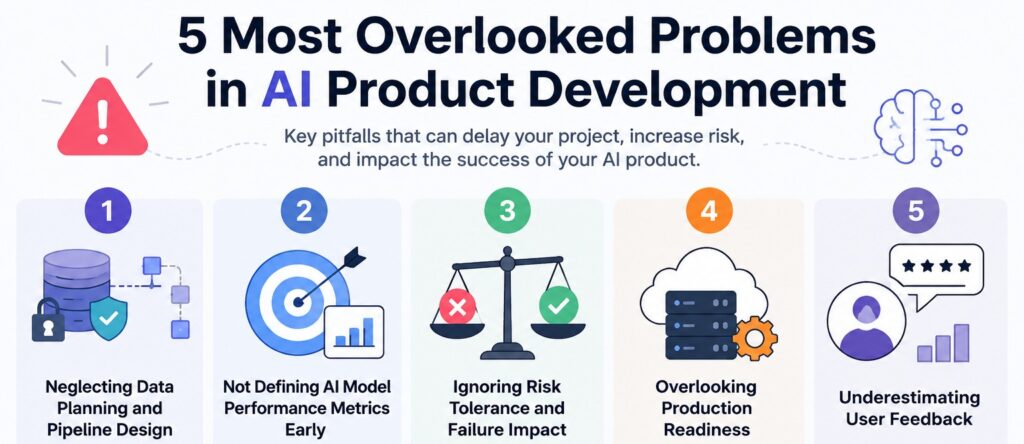
Based on those experiences, here are five of the most commonly overlooked problems in AI product development and why they matter far more than many teams initially expect.
1. Teams Consider Data Planning and Data Pipelines Too Late
One of the most common mistakes in AI projects is underestimating the importance of data operations and infrastructure design. Many teams begin with the idea that they should first gather data and quickly build a model to test whether the concept works. While this approach may seem efficient in the early stages, it often creates much larger problems later in the project.
In AI systems, data is not simply a resource used for training models. It becomes part of the long-term operational foundation of the product itself. This means that privacy, security, governance, storage policies, and data lifecycle management should be considered from the very beginning.
In practice, many projects realize too late that their datasets contain personally identifiable information or sensitive business data that cannot easily be used across development and production environments. As a result, teams are forced to redesign storage architectures, separate datasets, rebuild processing pipelines, or implement additional compliance controls late in the project timeline.
This issue is becoming even more important as global AI governance and data protection regulations continue to evolve. Organizations developing AI systems are increasingly expected to explain how data is collected, processed, stored, and reused throughout the AI lifecycle.
Another major issue that many teams overlook is the long-term design of the data pipeline itself. During the early stages of development, most attention is placed on improving model performance. However, AI products do not stop evolving after the first model is trained. They continuously require updated data, retraining workflows, validation processes, and monitoring systems to maintain quality over time.
Without a properly designed pipeline for data collection, cleaning, validation, retraining, and deployment, AI systems often degrade as user behavior, market conditions, and data distributions change. Recommendation engines become less relevant, document processing systems lose accuracy as formats evolve, and generative AI services gradually produce lower-quality outputs.
Successful AI products treat data not as a temporary project asset but as a long-term operational infrastructure that supports continuous improvement.
2. Teams Fail to Clearly Define AI Performance Metrics Early
Another major issue in AI product development is the lack of a clear definition for what “good performance” actually means.
In traditional software development, success is often relatively straightforward to measure. If a feature functions correctly according to specifications, the product is generally considered successful. AI systems are fundamentally different because their outputs are probabilistic rather than deterministic. AI models always operate with some degree of uncertainty.
Despite this, many AI projects begin development without clearly defining the performance standards that will determine success. As the project progresses, different stakeholders often develop entirely different interpretations of whether the AI system is performing adequately.
One person may believe the model is already producing acceptable results, while another may argue that the outputs are still too unreliable for real-world deployment. These disagreements become especially common in generative AI systems where evaluating output quality is far more subjective than measuring simple accuracy.
For example, how should teams evaluate the quality of an AI-generated answer? Is correctness enough, or should usefulness, clarity, tone, factual consistency, and user satisfaction also be included? Similarly, recommendation systems may show technically accurate predictions while still failing to create meaningful user engagement.
Without clearly defined evaluation criteria, AI projects often lose direction during later development stages. Teams continue adjusting models without a shared understanding of what improvement actually looks like.
This is why successful AI teams define performance metrics early in the project lifecycle. They establish measurable targets for accuracy, latency, hallucination frequency, recommendation relevance, user satisfaction, and operational reliability before large-scale development begins.
More importantly, they define acceptable thresholds from the user’s perspective. In many AI systems, the most important question is not whether the model is technically impressive, but whether the output quality is reliable enough for real users in real-world environments.
AI systems without clearly defined evaluation standards often resemble a ship navigating without a destination. No matter how much technical effort is invested, progress becomes difficult to measure consistently.
3. Teams Do Not Define Risk Tolerance for AI Outputs
AI systems are inherently imperfect. Even highly advanced models can generate incorrect recommendations, hallucinated answers, biased outputs, or unreliable predictions.
Most organizations understand this concept in theory. However, far fewer teams explicitly define how much risk or error is acceptable before deployment begins.
This becomes particularly important because not all AI errors have the same consequences. A poor movie recommendation may simply annoy users, while an incorrect financial recommendation or medical suggestion could create serious legal, ethical, or safety concerns.
Despite these differences, many AI projects postpone discussions about acceptable risk levels until the later stages of testing. When unstable or inconsistent outputs begin appearing, stakeholders suddenly start asking difficult questions about whether the system can actually be trusted in production.
At that point, the entire product strategy may begin to feel uncertain.
One of the biggest misconceptions in AI product development is the belief that user trust comes only from achieving higher model accuracy. In reality, trust often depends more on how the system handles mistakes when they occur.
Reliable AI products define clear policies regarding acceptable failures, escalation procedures, human review requirements, and communication strategies long before deployment. Teams should determine which types of errors are tolerable, which failures are unacceptable, when human intervention is required, and how users will be informed when uncertainty exists.
This approach is becoming increasingly important as organizations adopt AI governance frameworks and trustworthy AI standards. Regulatory expectations around explainability, accountability, safety, and risk management are steadily increasing across industries.
In practice, successful AI products are not necessarily the systems that never fail. They are the systems that fail predictably, transparently, and safely.
4. Operational Environments Are Considered Too Late
During the early phases of AI development, most teams focus heavily on experimentation and model performance. Teams prioritize collecting data, testing prompts, fine-tuning models, and improving benchmark scores.
While this focus is understandable, many projects underestimate how difficult AI operations become once systems move into production environments.
In real-world deployments, development and operational environments are often dramatically different. AI models that perform well during testing may encounter serious issues related to latency, infrastructure limitations, GPU costs, API reliability, scalability, or security restrictions once deployed to production systems.
In some cases, teams discover that the infrastructure used during development cannot support real-world traffic volumes or operational requirements. This forces organizations to redesign deployment architectures, optimize inference pipelines, or significantly increase operational budgets after development has already progressed.
AI services also introduce a much higher level of operational complexity compared to conventional software systems. Teams must continuously monitor model behavior, validate incoming data quality, detect performance degradation, manage retraining schedules, optimize infrastructure costs, and maintain service reliability.
As a result, AI operations become an ongoing engineering discipline rather than a one-time deployment activity.
This is why operational planning should begin much earlier in AI projects. Teams need to discuss infrastructure scalability, model redeployment strategies, rollback mechanisms, monitoring systems, and cost management during the initial design stages rather than after development is nearly complete.
In many successful AI products, operational design decisions have a greater long-term impact than the model architecture itself.
5. Teams Think About User Feedback Systems Too Late
Many AI projects focus intensely on improving models while paying far less attention to how user feedback will be collected and integrated after launch.
This is a major mistake because AI products improve primarily through continuous interaction with users.
Unlike traditional software systems, many AI products become more valuable over time only if they continuously learn from real-world usage patterns. Recommendation engines, generative AI assistants, conversational systems, and document intelligence platforms all rely heavily on user interaction signals to improve quality.
However, many teams postpone feedback design until the final stages before launch. As a result, feedback systems are often added hurriedly and lack the structure necessary to support meaningful long-term improvement.
Effective AI feedback systems should be designed from the beginning of the project. Teams should determine which user signals will be collected, how dissatisfaction will be measured, how incorrect outputs will be reported, and how user behavior data will influence retraining and evaluation processes.
User interactions such as correction behavior, retry patterns, escalation requests, satisfaction ratings, click behavior, and abandonment signals can provide extremely valuable information for improving model performance and identifying hidden weaknesses.
More importantly, strong feedback systems also improve user trust. When users feel that their feedback directly influences product improvement, they are often more willing to tolerate occasional AI limitations.
AI products are not static software releases. They are continuously evolving systems that depend heavily on learning from real-world human interaction.
Conclusion
AI product development requires a fundamentally different mindset from conventional software engineering.
Traditional software projects primarily focus on implementing stable features and predictable functionality. AI products require teams to simultaneously manage data infrastructure, model uncertainty, operational complexity, governance requirements, user trust, risk tolerance, and continuous feedback loops.
Looking back on many real-world AI projects, one lesson becomes increasingly clear: the success of an AI product is often determined less by using the newest AI model and more by how well the foundational operational structure was designed from the beginning.
The five problems discussed in this article are not unusual edge cases. They are recurring patterns that appear across AI projects of all sizes and industries.
Fortunately, these issues are also highly preventable. Teams that proactively address data operations, evaluation standards, risk tolerance, operational planning, and feedback systems early in development are often able to build AI products that are far more reliable, scalable, and trustworthy.
Ultimately, the most important question in AI product development may not be which AI model to choose, but how to build an AI system that can operate responsibly and sustainably as a real-world service over time.