
How Data Changes in the Age of Physical AI
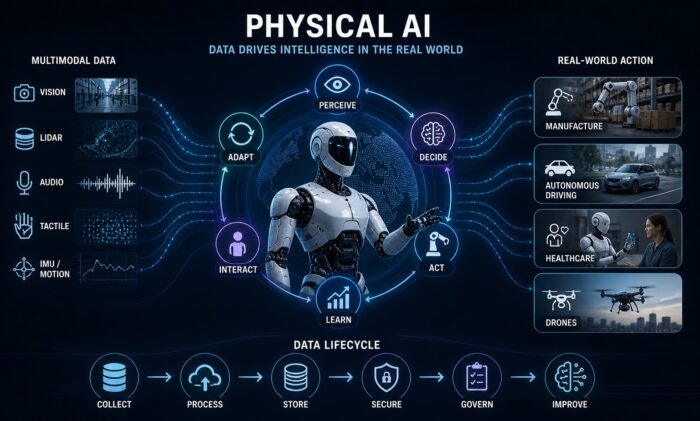
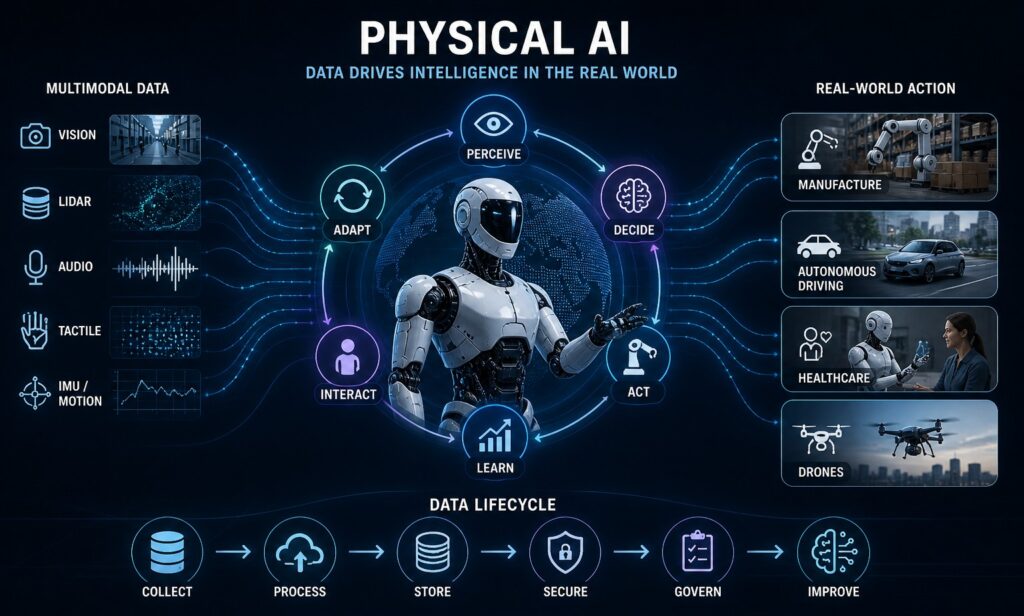
Artificial intelligence is rapidly moving beyond digital environments into the physical world, where it can perceive, decide, and act in real time. This shift has given rise to what we call Physical AI—intelligent systems embedded in robots, autonomous vehicles, smart factories, and healthcare environments. Unlike traditional AI, which primarily analyzes information and produces outputs, Physical AI operates within dynamic, real-world contexts where decisions must immediately translate into actions.
At the center of this transformation is data. In the past, data was largely treated as a static asset used for model training. In the Physical AI era, however, data becomes a continuous, real-time stream that drives every aspect of system behavior. According to McKinsey & Company, AI applications in physical environments could unlock trillions of dollars in economic value annually, particularly in sectors like manufacturing and logistics. This value is directly tied to how effectively organizations can collect, process, and utilize real-world data.
1. Core Characteristics of Physical AI Data
1.1 Real-Time and Continuous
In Physical AI systems, data is generated continuously and must be processed instantly. Unlike traditional AI workflows that rely on batch processing, Physical AI demands real-time responsiveness. Even minor delays can lead to incorrect decisions or safety risks, especially in applications like autonomous driving or robotic control. For instance, autonomous vehicles may generate terabytes of sensor data daily, requiring immediate interpretation to ensure safe navigation. This shift fundamentally changes the role of data from something stored and analyzed later to something that directly drives moment-to-moment decision-making.
1.2 Multimodal Fusion
Physical AI systems rely on a wide range of sensors, including cameras, LiDAR, microphones, and motion sensors. Each of these produces different types of data at different rates, making integration a complex challenge. The true value of data lies not in individual signals but in the ability to combine them into a coherent understanding of the environment. Companies like Tesla have demonstrated how integrating visual and sensor data enables more accurate real-world perception. In this context, success depends less on data volume and more on how effectively diverse data sources are fused.
1.3 Context-Aware Data
Data in Physical AI is deeply tied to context. The meaning of a signal depends on when and where it occurs, as well as the surrounding conditions. A simple action, such as a person moving quickly, may indicate exercise in one context but urgency or danger in another. Physical AI systems must therefore interpret not only raw data but also the situational context in which it occurs. This requires combining environmental data, temporal information, and behavioral patterns to make informed decisions.
1.4 Uncertainty and Noise Data
Sensor data in real-world environments is inherently imperfect. Noise, latency, and environmental variability introduce uncertainty that cannot be eliminated entirely. According to IEEE, handling uncertainty is one of the biggest challenges in robotics and autonomous systems. As a result, Physical AI systems must be designed to function reliably even when data is incomplete or partially inaccurate, making robustness a critical requirement.
1.5 Action-Oriented Data
Perhaps the most significant difference between traditional AI and Physical AI is that the latter is action-driven. Data is not just used to generate insights but to control physical behavior. It influences perception, decision-making, movement, and interaction in real time. In this sense, data becomes operational rather than informational, directly shaping how systems behave in the physical world.
2. Data Management Strategies for Physical AI
The unique characteristics of Physical AI data require a fundamental shift in data management strategies. Traditional approaches built around static datasets and offline analysis are no longer sufficient. Instead, organizations must adopt new methods that address real-time processing, scalability, and reliability across the entire data lifecycle.
2.1 Data Collection: Combining Real and Synthetic Worlds
Collecting high-quality data for Physical AI systems presents significant challenges. Real-world data is highly valuable because it reflects actual operating conditions, but it is often expensive, time-consuming, and sometimes unsafe to obtain. To overcome these limitations, organizations are increasingly adopting a hybrid approach that combines real-world data with simulation and synthetic data.
Real sensor data provides authenticity and captures the complexity of real environments, while simulation environments enable large-scale data generation under controlled conditions. Platforms developed by NVIDIA allow engineers to simulate thousands of scenarios, including rare or dangerous situations that would be difficult to reproduce in reality. When combined with human behavior data, this approach enables systems to learn not only how to operate but also how to interact effectively with people.
2.2 Data Processing: Building Real-Time Pipelines
In Physical AI systems, data must be processed as soon as it is generated. This requires a transition from batch processing to streaming architectures that support continuous data flow. Real-time pipelines ensure that sensor inputs are immediately analyzed and translated into actions.
Edge computing plays a crucial role in this process by enabling data to be processed close to where it is generated. This reduces latency and allows systems to respond quickly to changing conditions. Meanwhile, cloud infrastructure can be used for long-term analysis and model training. According to Gartner, a growing share of enterprise data processing is shifting toward edge environments, highlighting the importance of distributed architectures in modern AI systems. Together, edge and cloud systems create a balanced framework that supports both speed and scalability.
2.3 Data Storage: Prioritization Over Volume
The sheer volume of data generated by Physical AI systems makes it impractical to store everything. Instead, organizations must focus on storing data that provides the greatest value for analysis and learning. This requires a shift toward selective storage strategies.
Event-driven storage captures data only when significant events occur, such as anomalies or critical interactions. Importance-based sampling ensures that high-value data is retained while less relevant information is discarded. Additionally, compression and deduplication techniques help optimize storage efficiency. The key idea is that effective data storage is not about maximizing quantity but about preserving meaningful information that can improve system performance over time.
2.4 Data Quality Management: Automating Trust
Maintaining high data quality is essential for ensuring reliable AI performance. In Physical AI, where decisions directly impact real-world outcomes, poor data quality can have serious consequences. Sensor data must be continuously cleaned, validated, and monitored to ensure accuracy.
Automated pipelines are necessary to handle tasks such as noise filtering, anomaly detection, and label verification. These processes must operate in real time to keep up with the continuous flow of data. By automating quality management, organizations can ensure that their systems remain consistent and trustworthy even as data volumes grow.
2.5 Security and Privacy: Built-In, Not Optional
Physical AI systems often collect sensitive data, including images, voice recordings, and behavioral patterns. This raises significant concerns around privacy and security. Protecting this data is not optional—it must be an integral part of system design.
Techniques such as anonymization, encryption, and access control help safeguard sensitive information. In addition, regulatory frameworks are increasingly requiring organizations to implement privacy-by-design principles. This means that security considerations must be embedded from the earliest stages of development rather than added later.
2.6 Governance: Managing Data Lineage and Lifecycle
Effective data governance ensures that data remains reliable, traceable, and usable over time. In Physical AI systems, it is important to track where data comes from, how it was collected, and how it has been used. This information is critical for maintaining model accuracy and accountability.
Frameworks such as DataOps and MLOps provide structured approaches for managing data and model lifecycles. They enable continuous monitoring of system performance, helping organizations detect issues such as data drift or model degradation. By maintaining clear data lineage and version control, organizations can build systems that are both transparent and resilient.
From “Training Data” to “Evolution Engine”
In the Physical AI era, data is evolving from a static training resource into a dynamic engine of continuous learning. Systems are no longer trained once and deployed; they are constantly updated based on new data and real-world feedback.
Future data requirements will extend beyond traditional sensor inputs to include richer, human-centered information. This includes data related to human emotions, intent, social interactions, and collaborative behavior. As AI systems become more integrated into daily life, their ability to understand and respond to these complex signals will become increasingly important.
Conclusion
Physical AI represents a fundamental shift in how we think about artificial intelligence. It is no longer enough for systems to understand the world—they must be able to operate within it. This shift places data at the center of everything, from perception and decision-making to action and learning.
In this new landscape, success will depend not just on advanced algorithms but on how effectively data is managed across its entire lifecycle. Organizations that can design robust data strategies, build real-time processing capabilities, and ensure high standards of quality and security will be best positioned to lead in the Physical AI era.
Ultimately, data is no longer just an input to AI systems—it is the foundation upon which intelligent, real-world action is built.