
The Limitations of Traditional Data Management
For decades, traditional data management focused on one primary goal: storing and maintaining data for potential future use. Organizations invested heavily in data warehouses and data lakes, assuming that someone, at some point, would extract value from that information. Data quality was measured mainly by technical standards such as accuracy, consistency, and integrity. If the data was correct and safely stored, the job was considered complete.
This approach worked well for system stability and operational efficiency, but it gradually revealed serious limitations from a business perspective. Data volumes grew rapidly, yet many business teams struggled to turn that data into meaningful insights. A common complaint emerged: “We have plenty of data, but we don’t know how to use it.”
As a result, many organizations became data-rich but insight-poor. Traditional data management succeeded in building infrastructure, yet failed to ensure that data led to outcomes such as better decisions, automation, or revenue growth.
What Is a Data Product?
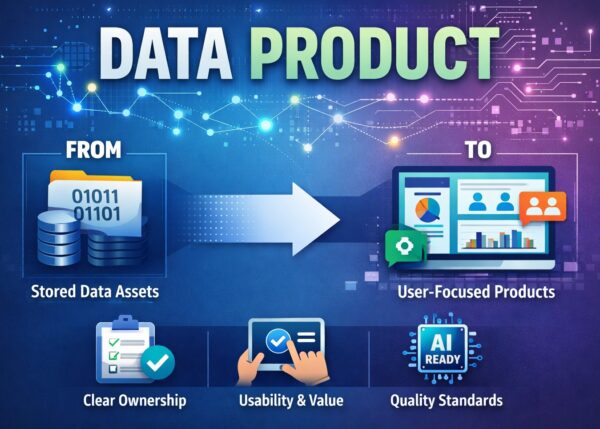
To overcome these limitations, a new concept has gained attention: the Data Product. A Data Product is not simply a dataset or a database table. It is a data-driven product designed and operated with a clear purpose, a defined user, and measurable value.
The key difference is that data itself is no longer the end goal. Instead, it becomes a means to solve specific problems for specific users. A Data Product answers three fundamental questions:
- Who is this data for?
- What problem does it solve?
- How should it be delivered so users can act on it immediately?
This represents a major shift in perspective. Data is no longer just an internal technical resource hidden inside platforms. It becomes something that directly delivers value, much like a software product or a digital service.
For example, a raw transaction table in a database is not a Data Product. A curated, well-documented “Daily Sales Performance Dataset” that store managers use every morning to guide decisions is a Data Product. The difference lies in purpose, usability, and ownership.
Why Data Product Matters in the Age of AI and Analytics
The rapid expansion of AI and advanced analytics is one of the strongest forces behind the rise of Data Product thinking. Organizations no longer compete based on who stores the most data. They compete based on who can use data most effectively.
The strategic question has shifted from “How do we collect and manage data?” to “How do we turn data into business value quickly and reliably?”
AI systems and analytics tools require data that is well-defined, consistent, and trustworthy. Without Data Products, data remains fragmented, poorly documented, and difficult to reuse. With Data Products, data becomes standardized and aligned with concrete business use cases such as fraud detection, customer churn prediction, or supply chain optimization.
In this sense, Data Product serves as the missing bridge between raw data infrastructure and real business outcomes.
Designing a Data Product: Starting with Users and Purpose
Designing a Data Product always begins with the user and the problem to be solved. Instead of focusing first on technology, teams focus on how the data will actually be used in real scenarios.
Traditional data management was system-centered. Data Product design is user-centered and scenario-driven. A retail company, for instance, might move from simply storing transaction records to creating a “Store Performance Data Product” designed specifically for regional managers, with standardized KPIs and guaranteed freshness.
A well-designed Data Product typically includes:
- A clearly defined target user group
- A specific business problem it addresses
- A standardized delivery format such as an API, dashboard, or machine-learning feature table
- Quality standards tied to business usage rather than technical metrics alone
This shift also changes how data quality is defined. Quality is no longer just about correctness. It becomes about fitness for use. The central question becomes whether the data can be used directly for decision-making without additional processing or interpretation.
From Platform-Centric Data to Product-Centric Data
Historically, data lived inside centralized platforms such as data warehouses and BI tools. These systems were optimized for storage and performance, not for user experience or accountability.
With Data Product thinking, data becomes an independent product that happens to run on a platform. This change has important implications for governance, ownership, and delivery. Instead of a single central team owning all data, domain teams take responsibility for their own Data Products.
This product-centric approach leads to several practical shifts:
- Data governance becomes driven by usage rather than rigid rules
- Documentation becomes as important as the data itself
- APIs and data contracts replace ad-hoc queries
- Business teams gain greater trust in the data they consume
As a result, data becomes something people can rely on, not just something they can access.
In the past, data was treated as a static asset—something to collect and preserve. In modern organizations, data must be continuously improved, reused, and refined, much like software.
A true Data Product evolves over time. It incorporates user feedback, adapts to new business needs, and delivers repeatable value. This requires a new operating model in which planning, ownership, quality, and accountability are clearly defined.
A mature Data Product typically demonstrates:
- Clear ownership and responsibility
- Defined service levels for freshness and reliability
- User-focused design
- Easy discoverability and understanding
- High trust and consistent meaning
When these elements are in place, data stops being a passive resource and becomes an active driver of business performance.
In an era of AI, analytics, and digital transformation, Data Product is no longer a nice-to-have concept. It is a strategic necessity.
Organizations that continue to focus only on storage and pipelines will struggle to scale AI initiatives, democratize analytics, and generate measurable returns from data investments. By contrast, organizations that adopt Data Product thinking achieve faster decision-making, stronger trust in data, and closer alignment between business strategy and technology execution.
Conclusion
The future of data is not about collecting more of it. It is about creating more value from it. Data Product represents a fundamental mindset shift—from storing data to serving users, from managing assets to delivering products, and from technical success to business impact.
In the age of AI and advanced analytics, organizations must move beyond traditional data management. They must design, operate, and continuously improve Data Products that solve real problems for real users.
Data is no longer just something you own. It is something you build, refine, and deliver—just like any other product. And the organizations that understand this first will lead the next wave of data-driven innovation.