
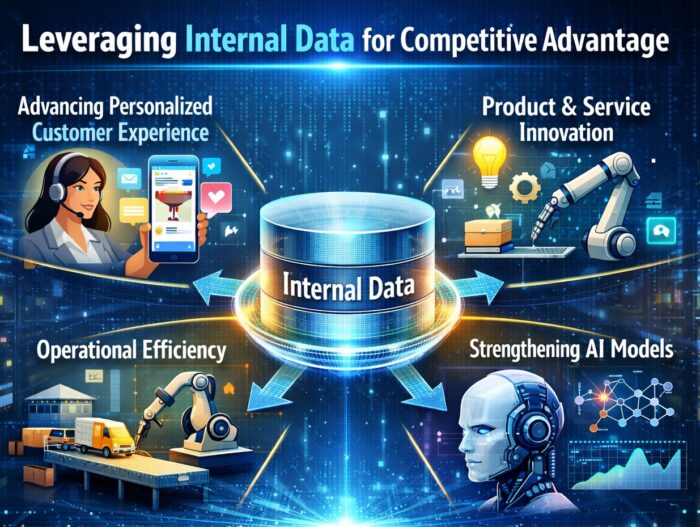
Introduction
In previous discussions, we have repeatedly emphasized the importance of internal enterprise data and data security. Now it is worth revisiting a more fundamental question: what does it actually mean, from an AI perspective, for a company to own a large volume of high-quality internal data?
Artificial intelligence has evolved far beyond simple keyword search. Today’s AI systems are capable of summarization, structured reasoning, advanced analytics, and even multi-step inference. In specialized domains such as finance, healthcare, and manufacturing, AI models can already analyze complex datasets faster than humans and generate actionable insights that directly inform decision-making.
However, there is a critical reality that many organizations overlook. As AI capabilities become more accessible, baseline AI performance is quickly becoming a commodity. The true challenge for enterprises is no longer whether they can use AI, but whether they can use AI in a way that creates unique and defensible business value. The factor that enables this differentiation is internal enterprise data.
The Core Concept Behind AI Competitiveness: “Customized”
Modern AI models are undeniably powerful even without access to internal enterprise data. Trained on vast public datasets, they can answer questions, generate content, analyze documents, and assist with complex reasoning tasks across industries.
But once AI systems are connected to internal organizational data, their role changes fundamentally. At that point, AI stops being a generic productivity tool and becomes an enterprise-specific intelligence layer—one that understands the company’s customers, operations, products, and historical decisions.
This transformation is driven by a single concept: customization.
Internal enterprise data contains context that external datasets simply cannot provide. It captures how customers actually behave, how internal processes really operate, and how decisions have historically been made. These signals are unique, cumulative, and extremely difficult for competitors to replicate.
As a result, AI systems trained or augmented with internal data can deliver insights and outcomes that generic AI systems never will. This raises an important question: what concrete advantages does internal data create when viewed through the lens of customized AI?
The Competitive Advantages of Internal Enterprise Data
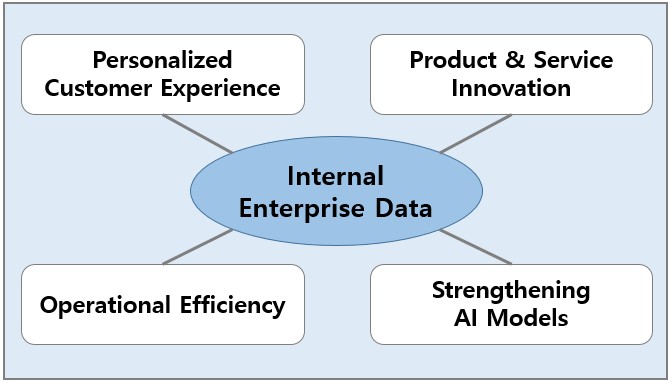
1. Advancing Personalized Customer Experience
The most immediate and visible impact of internal data-powered AI is on customer experience. Internal customer data—such as purchase history, usage patterns, service interactions, and behavioral logs—provides AI with a rich understanding of individual preferences and intent.
When analyzed effectively, this data enables organizations to:
- Deliver highly personalized product and content recommendations
- Predict customer churn and proactively intervene
- Provide tailored AI-driven customer support through intelligent chatbots
The business impact of personalization is well-documented. According to McKinsey, companies that excel at personalization generate 40% more revenue from those activities than average players, and personalization can lift revenues by 10–15% while reducing acquisition costs (McKinsey & Company, 2021).
What makes this advantage especially powerful is that customer interaction data is largely inaccessible to outsiders. This means internal customer data becomes both the foundation of AI-driven personalization and a durable competitive moat.
2. Product and Service Innovation Driven by Internal Insights
Internal enterprise data plays an equally critical role in product and service innovation. Even without using personally identifiable information, organizations can analyze aggregated usage patterns to identify friction points, unmet needs, and opportunities for improvement.
External data often highlights broad market trends, but internal data reveals how real users interact with your specific product or service. This distinction matters. Decisions driven by internal usage data are grounded in actual behavior rather than assumptions or generalized benchmarks.
For example, digital product teams frequently use internal telemetry data to refine user flows, prioritize feature development, and eliminate underused functionality. Over time, this feedback loop enables continuous, data-driven innovation that competitors relying on external insights alone struggle to match.
In practice, internal data becomes the most reliable compass for long-term product direction.
3. Operational Efficiency, Cost Reduction, and Data-Driven Decision-Making
Across industries—from manufacturing and logistics to e-commerce and platform businesses—operational efficiency directly translates into competitiveness. Internal operational data is the key input that allows AI to optimize these complex systems.
Every organization has unique workflows, legacy systems, and operational constraints. These realities cannot be understood or improved by AI without deep exposure to internal process data. Applying AI without this context often leads to disappointing results.
When AI is grounded in internal operational data, organizations can achieve measurable improvements such as:
- Demand forecasting that reduces excess inventory
- Supply chain optimization that improves delivery reliability
- Predictive maintenance that lowers downtime and defect rates
More importantly, this shift replaces intuition-based decision-making with data-driven operational intelligence. When real-time internal data is combined with AI, organizations move from reactive responses to proactive and preventive operations—tailored to their own operational realities.
4. Strengthening AI Models Themselves
Internal enterprise data does not only improve business outcomes; it directly strengthens the AI models behind them. In domains such as autonomous driving, robotics, speech recognition, and image analysis, internal datasets are often the primary source of competitive advantage.
Models trained exclusively on public datasets may perform well in general scenarios, but they lack specialization. Internal data allows organizations to:
- Train AI models optimized for specific environments and use cases
- Continuously improve accuracy and inference performance
- Build AI systems that competitors cannot easily replicate
This is why leading AI-driven companies treat internal data as a strategic asset rather than a byproduct of operations. With continuous data collection and model refinement, AI capabilities improve over time, reinforcing long-term competitive differentiation.
Conclusion
When AI systems are able to fully leverage internal enterprise data, organizations unlock advantages across the entire value chain—from personalized customer experiences and product innovation to operational excellence and AI model differentiation.
The success of AI adoption ultimately does not hinge on algorithms alone. It depends on how well internal data is managed, governed, and made accessible for AI use.
In the AI era, data is no longer a passive resource. Well-structured, high-quality internal enterprise data is both a company’s present competitive edge and the foundation of its future growth. Organizations that recognize this early will not only adopt AI more effectively—they will define what meaningful AI-driven value looks like in their industry.