
Introduction
Artificial Intelligence is no longer an experimental technology reserved for innovation labs. It has become a foundational layer of modern digital services, fundamentally changing how businesses operate. Over the past decade, Software as a Service (SaaS) reshaped enterprise IT by moving software delivery to the cloud. Today, a new shift is emerging—one that goes beyond cloud-based tools and into autonomous execution.
This shift is often summarized by a phrase increasingly heard in Silicon Valley: “AI is eating software.” What this really means is not that software is disappearing, but that traditional, function-driven software is being absorbed into more intelligent, autonomous systems. At the center of this transition is Agentic AI, and its service-oriented manifestation: Agentic AI as a Service (AaaS).
This article explores what AaaS is, how it differs from traditional SaaS, why it is becoming critical for modern organizations, and what the future holds for this new service paradigm.
What Is Agentic AI as a Service (AaaS)?
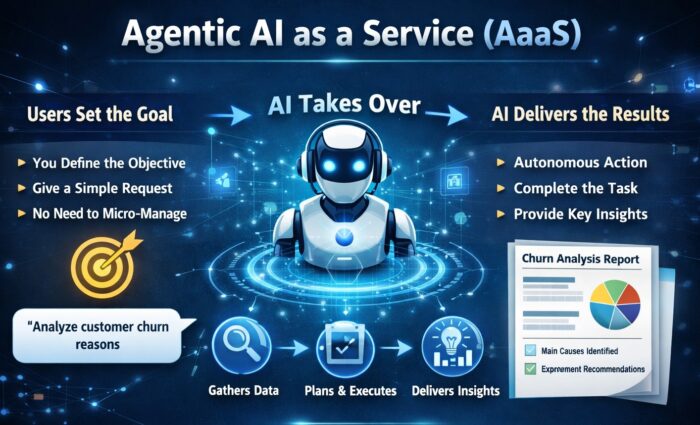
Agentic AI as a Service can be most simply described as ‘AI that takes responsibility for outcomes, not just outputs‘. Traditional AI systems respond to prompts or automate predefined steps. AaaS systems, by contrast, are designed to understand a goal, decide how to achieve it, and execute the necessary actions autonomously.
When a user provides a high-level objective, an Agentic AI does not wait for further instructions. Instead, it independently navigates the steps required to reach a result. In practice, this typically involves:
- Identifying and collecting relevant data
- Creating a plan or sequence of actions
- Executing tasks across connected systems
- Iterating and improving based on intermediate results
- Delivering insights, recommendations, or completed work
Because the user focuses on what they want rather than how to do it, AaaS represents a shift from AI as a tool to AI as an active participant in work. In many cases, it functions like a digital colleague—one that never tires, scales instantly, and continuously learns from experience.
The market for Agentic AI services is still in its early stages, but growth projections are aggressive. Analysts estimate that the Agentic AI market will expand from single-digit billions today to tens of billions of dollars over the next decade, driven by enterprise adoption and platform integration.
Major technology vendors are already positioning AaaS as a core growth engine. Cloud providers, productivity software companies, and enterprise SaaS vendors are embedding agentic capabilities into their offerings, signaling that autonomous AI will soon become a default expectation rather than a differentiator.
Over the long term, AaaS is widely viewed as a practical stepping stone toward more generalized artificial intelligence, offering immediate business value while pushing autonomy further into everyday workflows.
How AaaS Differs From Traditional SaaS
Traditional SaaS platforms are fundamentally feature-driven. They provide users with dashboards, buttons, workflows, and configuration options that must be actively managed by humans. Even advanced automation within SaaS is usually limited to predefined rules and triggers.
For example, when using a CRM platform, a sales or marketing team must still decide what data to analyze, which reports to run, and how to interpret the results. The software supports the process, but humans remain responsible for planning and execution.
AaaS inverts this relationship. Instead of navigating features, users describe an objective—such as analyzing customer churn or optimizing campaign performance—and the AI determines how to proceed. It may analyze multiple datasets, identify causal patterns, and generate actionable recommendations without human intervention at intermediate stages.
This difference can be summarized simply: ‘SaaS provides tools, while AaaS delivers outcomes‘. Where SaaS requires continuous user input, AaaS emphasizes autonomy, reasoning, and decision-making.
Why AaaS Is Becoming Critical for Modern Business
The rise of AaaS is driven by structural changes in how organizations operate, not just by improvements in AI technology. Modern businesses face increasing complexity, tighter timelines, and growing data volumes that exceed human processing capacity.
One major factor is the explosion of enterprise data. Companies now collect information from CRM systems, analytics platforms, customer interactions, and operational logs at an unprecedented scale. While SaaS platforms store and visualize this data, turning it into timely decisions remains a bottleneck.
Another critical driver is the rapid maturation of large language models and agent frameworks. These technologies allow AI systems to understand context, reason through multi-step problems, and adapt their strategies dynamically. As a result, AI agents can now manage tasks that previously required human judgment.
Cost dynamics also play a role. Cloud infrastructure and AI inference costs are gradually declining, making it economically viable to deploy autonomous agents at scale. Together, these trends are accelerating the transition from ‘function-based software‘ to ‘result-oriented AI services‘.
AaaS in Action: Real World Examples Driving Adoption
AaaS is already appearing across industries, often embedded within existing enterprise platforms. In customer service, Agentic AI systems can diagnose issues, determine resolution paths, interact with backend systems, and close tickets end-to-end. In sales and marketing, agents can analyze lead quality, personalize outreach, and forecast pipeline risks without manual analysis.
Operationally, finance teams are beginning to use Agentic AI to reconcile transactions, monitor compliance, and surface anomalies automatically. In supply chain environments, autonomous agents can forecast demand, adjust procurement strategies, and flag disruptions before they escalate.
What makes these examples compelling is not just automation, but decision ownership. The AI does not merely assist—it acts, evaluates outcomes, and refines its approach over time.
The Core Features That Make AaaS Unique
While implementations vary, most AaaS platforms share several defining characteristics that distinguish them from earlier AI-enabled services.
First, AaaS systems are inherently goal-driven. They operate around user-defined objectives rather than static inputs and outputs, enabling flexible execution paths depending on context.
Second, they rely heavily on multi-agent collaboration. Instead of a single monolithic AI, multiple specialized agents handle tasks such as data analysis, decision-making, execution, and validation. This division of labor improves scalability and robustness.
Finally, AaaS platforms tend to be domain-optimized. Rather than offering generic intelligence, they are tailored for specific industries such as healthcare, finance, legal services, or human resources, where contextual accuracy is critical.
Current Challenges AaaS Must Overcome
Despite its promise, AaaS is not without challenges. One of the most significant is the risk of hallucination or incorrect reasoning, particularly in high-stakes environments. Autonomous decision-making requires strong validation mechanisms and human oversight in sensitive scenarios.
Security and privacy are equally important. Because Agentic AI systems often need access to multiple enterprise systems, strict governance, access control, and auditability are essential.
Cost efficiency also remains a concern. Running multiple intelligent agents can be resource-intensive, and organizations must carefully evaluate whether the value delivered justifies the expense.
Conclusion
Agentic AI as a Service represents more than a new category of software—it marks a fundamental shift in how work gets done. The industry is moving from a world where humans operate software to one where AI systems actively execute work on behalf of humans.
In this emerging landscape, competitive advantage will not come from who has the most features, but from who can deploy the most effective AI agents to deliver results. As organizations prepare for this future, AaaS is no longer an optional experiment. It is a strategic direction that forward-thinking businesses must begin to understand and adopt.