
Introduction
In today’s data-driven economy, businesses thrive not just by collecting information, but by using it strategically to guide decisions, improve services, and gain a competitive edge. To achieve this, a well-defined data roadmap is essential.
A data roadmap isn’t just a schedule for gathering data—it’s a comprehensive framework that governs how data is acquired, used, and continuously improved across the organization. It bridges strategic intent and operational reality, ensuring that every dataset serves a clear purpose.
However, even the most detailed roadmap can fall short without systematic data planning. Data planning ensures that the right data is accurate, accessible, and actionable when it’s needed most. Without it, organizations risk wasted resources, compliance issues, and missed opportunities.
This article explores how to bridge the gap between strategy and execution—how a strong data roadmap, paired with disciplined planning, unlocks the full value of data.
The Importance of a Data Roadmap
A data roadmap lays out both the short-term and long-term strategies an organization will use to manage, govern, and activate its data. It goes beyond simple documentation and establishes a structured plan for how data will support business goals. A strong roadmap clarifies foundational questions such as:
- What data should be collected, and why does it matter for the business?
It ensures that teams prioritize high-value data rather than capturing everything indiscriminately. - When and how should the data be acquired?
This includes defining sources, ingestion methods, required frequency, and the level of automation needed to maintain consistency and reliability. - How will the data be used, monitored, and measured for impact?
A roadmap outlines the analytics and AI use cases the data will feed, along with clear metrics to evaluate data quality, business value, and return on investment.
Ultimately, a well-designed data roadmap helps organizations move from reactive data management to a proactive, strategic approach—one that ensures data becomes a scalable asset rather than a fragmented operational burden.
Stage 1: Data Acquisition Strategy
The first stage involves identifying which data is needed and determining how and when to collect it. Getting the timing right is crucial—data collected too early can become outdated, while delays can limit its usefulness.
Most organizations begin with internal data—for instance, customer transactions, app logs, or supply chain data. If gaps exist, they can generate new data via IoT devices, apps, or surveys. External data sources—from open datasets to commercial APIs—can enrich insights.
All data collection must align with broader business strategies—product, service, and technology roadmaps—so that evolving priorities still have relevant data support.
Stage 2: Data Utilization and Performance Management
Collecting data is only step one; turning it into measurable value is what matters. Organizations leverage data for analytics, AI modeling, and operational improvements—but must also evaluate whether these efforts deliver ROI.
Regular performance analysis helps identify gaps, refine models, and optimize both collection and usage. This feedback loop ensures that a data roadmap evolves alongside market realities.
Stage 3: Continuous Improvement
A successful data roadmap is cyclical—acquire, use, measure, refine. A dedicated data operations (DataOps) team ensures consistent oversight and continuous optimization.
As new products, markets, and technologies emerge, teams can adjust strategies without losing alignment between business goals and data capabilities. Continuous improvement keeps the roadmap relevant, dynamic, and results-focused.
Translating a Roadmap into Action: Data Planning
While the roadmap defines direction, data planning operationalizes it, ensuring that data is trustworthy, accessible, and usable in real time. Poor planning often results in delayed product launches, poor-quality insights, or compliance failures—especially when dealing with personal data under regulations such as the GDPR or California Consumer Privacy Act (CCPA).
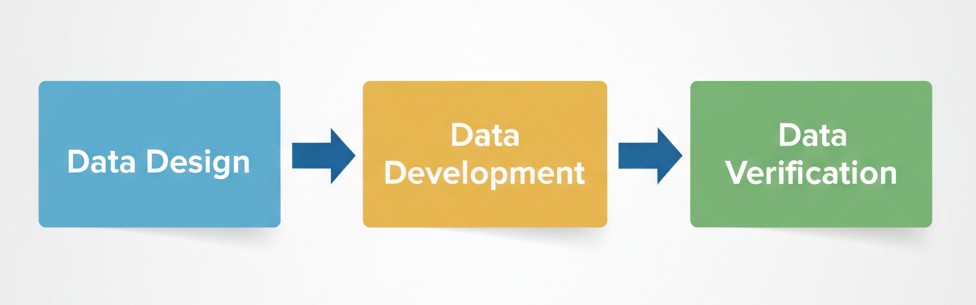
Effective data planning typically includes three stages: design, development, and verification.
Stage 1: Data Design
The design stage lays the foundation for data planning by clearly defining the types of data required and their intended use. This data can come from multiple sources, including information generated by products such as sensors, IoT devices, or embedded hardware; data produced through digital services, like e-commerce platforms, portals, or customer interactions; and internal operational data from areas such as human resources, finance, procurement, or facilities management.
When personal data is involved, companies must ensure compliance with privacy regulations and internal policies. Design also includes determining storage and processing environments—whether cloud-based, on-premises, or hybrid—and aligning data governance, product, development, and QA teams on standards for validation, management, and usage.
Stage 2: Data Development
After the design stage, the development phase puts the data plan into action. This involves implementing processes to capture the required data, which may include building software features specifically for data collection, deploying additional hardware sensors, gathering logs or user input, and integrating external datasets to complement the organization’s internal data sources.
Consistency is critical: data should conform to standardized formats and types, with collection cycles—batch or real-time—aligned with intended use cases. This stage ensures that data is not only collected but also structured for downstream analysis and AI applications.
Stage 3: Data Verification
The verification stage ensures that the collected data is accurate, complete, and ready for use. During this process, organizations confirm that the gathered data meets the defined requirements, validate that formats and types are consistent, identify and address any gaps, errors, or outliers, and check that the data collection cycles align with the specifications established during the design phase.
Maintaining a data catalog after verification enables analysts and AI teams to quickly locate and use reliable datasets, reducing time spent cleaning or preparing data.
Why Systematic Data Planning Pays Off
Integrating data planning into business and product processes ensures smoother operations and better decision-making. For hardware products, embedding planning into the development lifecycle avoids disruptions. For software and AI services, incorporating planning into system design and testing ensures data quality is maintained from day one.
The ultimate goal is to treat data as a high-value organizational asset. Proper planning prevents wasted effort, reduces compliance risks, and accelerates reliable service launches. Although it requires upfront investment, the benefits far outweigh the initial effort, saving organizations from major challenges down the road.
Turning Data into Strategic Value
When a data roadmap is paired with disciplined, systematic data planning, organizations unlock far more than operational efficiency—they turn data into a true strategic advantage. Instead of treating data as a passive byproduct of business activity, this combined approach enables teams to actively shape how data is collected, organized, and leveraged across the enterprise.
With both elements working together, organizations can extract meaningful insights faster and with greater confidence. They can also make smarter decisions about where to invest in data initiatives, ensuring that every project directly supports core business priorities rather than becoming another disconnected effort. This alignment ultimately leads to more consistent delivery of high-quality products, services, and customer experiences.
At the strategic level, the data roadmap sets the direction. It defines the vision, priorities, and long-term outcomes the organization aims to achieve. Data planning, on the other hand, turns that strategy into action—laying out the processes, standards, timelines, and governance needed to execute effectively.
Together, they form a powerful framework that helps companies fully harness their data, driving growth, operational efficiency, and innovation in an increasingly competitive, data-driven world.