
Introduction
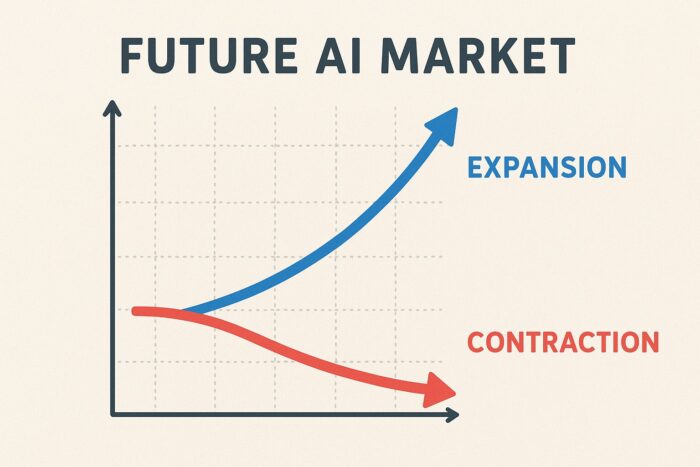
The global artificial intelligence (AI) market is entering a phase of explosive expansion — but also one that demands discernment. According to a June 2025 report from Precedence Research, the market is projected to grow from approximately US $638.2 billion in 2025 to US $3.68 trillion by 2034, representing a striking compound annual growth rate (CAGR) of 19.2%. (Source: Precedence)
Breaking this down further, AI software remains the largest segment (over 45% of total market share), followed by AI services (about 35%) and AI hardware (around 20%) — a distribution that reflects both the maturity of the software layer and the growing importance of specialized chips such as NVIDIA’s H100 and Google’s TPU.
Yet these impressive figures raise a critical question:
Do market numbers truly reflect real, sustainable business value — or just another wave of tech hype?
Big Numbers… but Growing Fatigue
The momentum behind AI is undeniable. From finance and healthcare to manufacturing and media, organizations are investing billions into AI tools, generative models, and automation platforms. However, there’s growing fatigue around the relentless “AI revolution” narrative. Terms like “overhyped,” “under-delivering,” and “unsustainable” have begun surfacing in boardrooms and analyst reports alike.
A 2024 Gartner forecast predicts that over 40% of AI agent projects (so-called “AI Agents”) could be canceled by 2027, citing escalating costs, unclear ROI, and weak governance. (Source: Gartner) Similarly, Stanford’s 2025 AI Index found that while investment in generative AI surpassed $25 billion in 2024, only about one-third of enterprises reported measurable ROI from these initiatives. (Source: Stanford University)
These figures reveal a deeper truth about today’s AI landscape: simply attaching the label “AI” to a project doesn’t guarantee meaningful impact. In fact, many initiatives stall—or collapse entirely—not because the underlying technology is flawed, but because the foundational business structures around it are missing. Too often, organizations launch AI efforts without establishing clear ROI metrics, making it nearly impossible to evaluate whether the project is actually creating value or merely generating activity. Without measurable outcomes, even technically impressive systems struggle to justify continued funding.
Another common failure point is the absence of a well-defined business use case. Companies adopt AI out of competitive pressure or executive enthusiasm, but with no specific operational pain point to solve. As a result, teams end up building prototypes that don’t integrate with real workflows or address practical needs, leaving stakeholders unconvinced and budgets under scrutiny.
Equally important is the architecture behind the model. AI systems depend on scalable, well-governed data pipelines, yet countless organizations still operate with fragmented data silos, inconsistent schemas, and legacy infrastructure that can’t support modern workloads. And without strong governance—covering security, compliance, privacy, and model drift—projects become operational risks rather than strategic assets.
Ultimately, the lesson is clear: AI succeeds not when it is hyped, but when it is grounded in measurable value, tied to real business outcomes, and supported by solid data and governance foundations.
Maximizing the Impact of AI Adoption
Getting tangible value from AI isn’t about acquiring the most advanced model. It’s about aligning AI with business strategy, data readiness, and operational sustainability.
1. Define what an AI Agent really is.
For your organization, an AI agent should drive autonomy, efficiency, and measurable improvement, not merely act as an automated chatbot with no decision-making depth.
2. Choose strategic—not trivial—use cases.
For instance, automating invoice data entry can be handled more efficiently by rule-based RPA. Save AI for high-complexity domains like fraud detection, dynamic pricing, or predictive maintenance — areas where adaptability and reasoning truly matter.
3. Measure business impact.
Identify KPIs such as cost reduction, time-to-decision, customer satisfaction, or revenue uplift. Companies that carefully track and measure the impact of their AI initiatives are much more likely to see positive returns than those that don’t.
4. Feed the loop.
Successful AI systems are not static. Design workflows so that outputs continuously inform new data pipelines, improving performance over time — a virtuous cycle that compounds results rather than decays.
Focus and Prioritization Are Key
As the AI market balloons, one of the greatest risks is indiscriminate adoption — implementing AI simply because “everyone else is doing it.” Instead, leaders should ask: “Will this move the needle?”
Here’s how to focus effectively:
- Start with high-impact areas.
Move from simple automation to true autonomy. For example, Toyota’s AI-driven predictive maintenance systems have reduced factory downtime by 15–20%, illustrating how targeted use delivers measurable gains. (Source: Toyota) - Get the architecture right.
Data quality, governance, and monitoring are non-negotiable. According to a report by MIT Technology Review Insights in partnership with Snowflake, a large majority of organizations remain unprepared to fully capitalize on generative AI—a key reason being weak data foundations. (Source: MIT) The research found that about 78% of companies reported inadequate or shaky data infrastructure as a major barrier to deploying and scaling AI. - Scale selectively.
Pilot first, measure results, and scale only when value is proven. Global leaders like Amazon and UPS have succeeded with this “test-and-learn” model, expanding only after validating ROI.
Creating a Virtuous Cycle of AI-Driven Growth
When organizations apply AI thoughtfully and with strategic intent, it stops being just another technology expense and becomes a self-reinforcing engine for long-term growth. Successful AI adoption usually follows a predictable, disciplined progression. It begins with identifying a concrete business challenge—such as reducing customer churn, improving supply-chain forecasting, or optimizing dynamic pricing—so the AI solution is anchored to a measurable problem rather than abstract ambition. From there, teams deploy a targeted model with clearly defined KPIs and ROI expectations, ensuring the initiative is evaluated against tangible outcomes rather than vague notions of “innovation.”
As the system begins operating, real-world performance data is captured and analyzed, revealing patterns, gaps, and emerging opportunities. These insights are then fed back into the model, enabling it to be retrained and refined over time. Each iteration makes the system more accurate, more context-aware, and better aligned with the organization’s goals. Once a use case consistently proves its value, companies scale it across teams, markets, or product lines, turning isolated wins into enterprise-level impact.
This ongoing “AI learning loop”—exemplified by leaders like Netflix, which continually enhances content recommendations, and Salesforce, which refines predictive lead scoring—shows how deliberate feedback and iteration can transform one-off experiments into durable competitive assets that grow stronger with every cycle.
Conclusion
The global AI market is expanding at an extraordinary pace, offering opportunities unlike anything businesses have seen before. Yet with that promise comes a very real set of risks. As AI capabilities accelerate and new tools flood the market, organizations feel increasing pressure to adopt them quickly. But history makes one thing clear: companies that chase the hype rather than the outcome often end up with stalled projects, wasted budgets, and little to show for their efforts.
A more effective approach begins with intention and discipline. It starts by selecting use cases that truly matter—problems whose solutions will materially improve customer experience, efficiency, or revenue. From there, companies must invest in strong data foundations, because even the most advanced models fail without trustworthy, well-governed data behind them. Progress must then be measured relentlessly, ensuring each initiative creates measurable value rather than simply activity. And finally, organizations should scale only what works, refining the system through continuous iteration.
When AI initiatives are anchored to genuine business goals, the technology stops functioning as a short-lived experiment and becomes a strategic differentiator that compounds over time. As AI investment continues to surge globally, the organizations that prioritize value—not volume—will be the ones that define the next era of intelligent, sustainable growth.